POHARA, NEPAL
Per instructions, I was ready the next morning. I had two plastic bags full of my personal items checked at the hotel, my duffel packed for my porter, and my backpack. We were at the KATHMANDU airport by 8 AM for our 8:50 flight to POKHARA. Passing through security reminded me of the US airport security before 9/11. From airport to airport, I only saw one white person. We’re off to a good start!
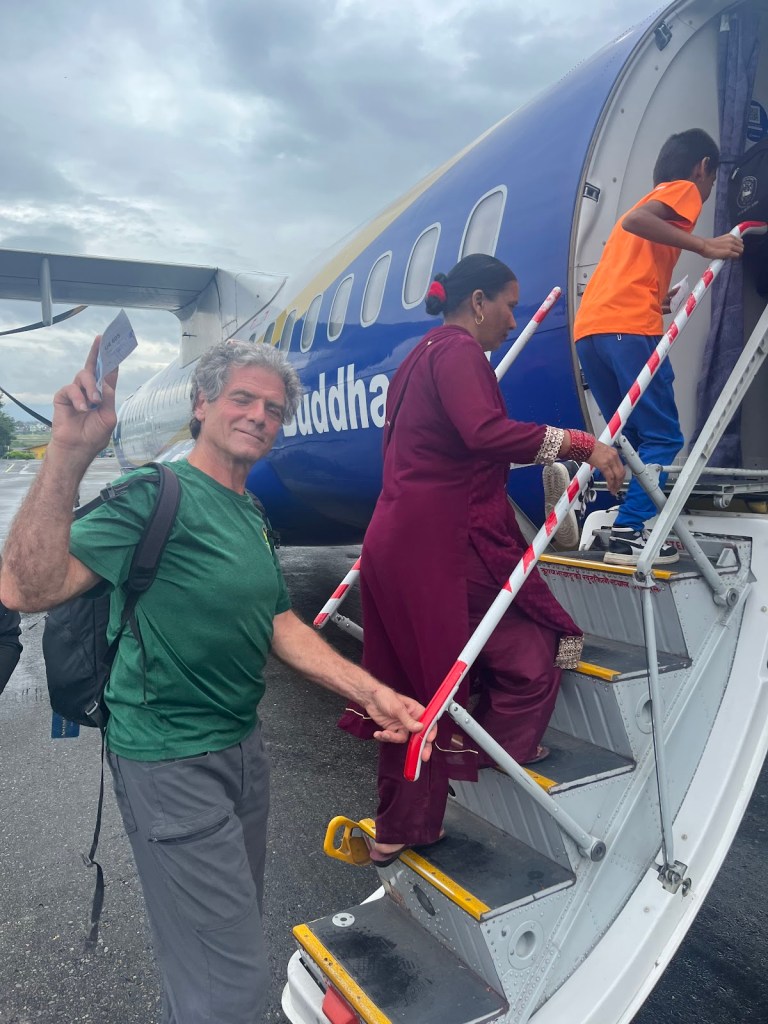
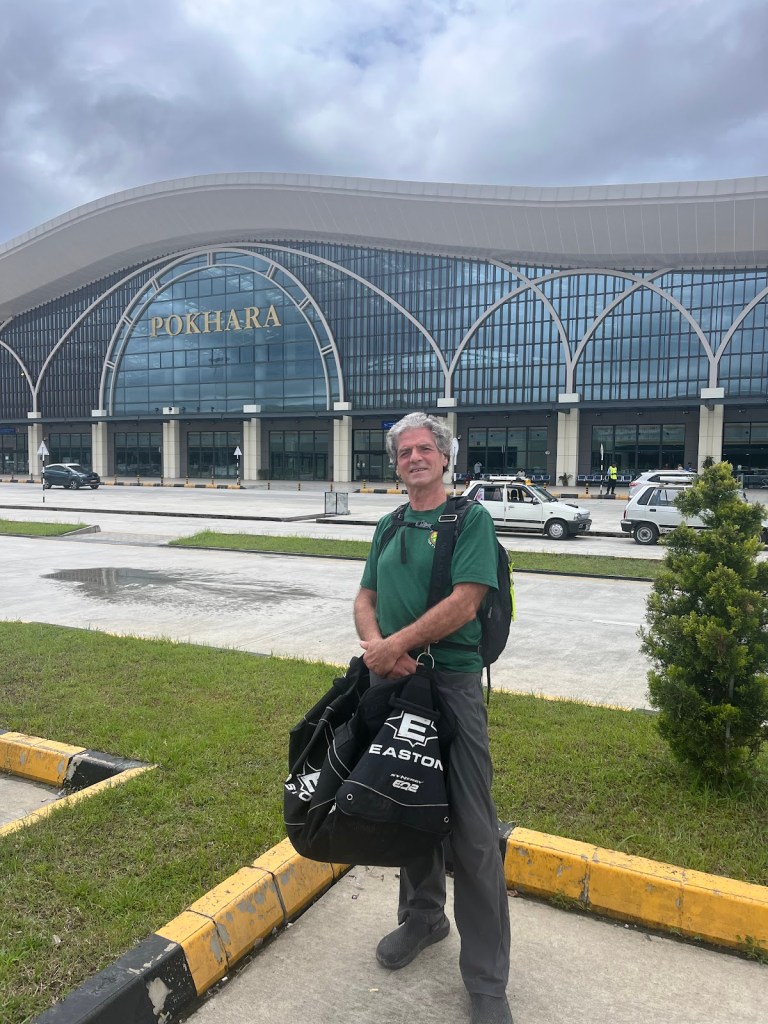
The POKHARA airport was modern and recently renovated. I liked the tile. We met our driver who had a rugged-looking jeep that would be necessary to get to our destination, a tiny village called HILE. A few miles into town, we picked up Hari, my porter, and began our 2 ½ hour drive. I found POKHARA to be better organized and cleaner than anywhere since leaving New York. After my trek in the mountains, my agenda included a tour of POKHARA later that week.
We needed to stop at the ANNAPURNA Conservation office to get a permit. This is required as it will need to be presented on the trail. No Permit? Turn around and go back. You also need a guide, so Rishi took care of business while I checked out the river from the bridge.

The roads varied from good to very rough in places, and when we entered the foothills of the HIMALAYAS, things would deteriorate rapidly. So far, this trip was a series of memorable moments, and the one that I was about to take place I will likely remember most because I will never forget how scared I was! We traversed up and down switchbacks that were very rough and rocky and encountered water flowing across the primitive road. In some cases, the water flowing across our road was in pretty heavy volume.
Only about ½ mile from HILE, we came upon a “stream” crossing that was now a river in the monsoon season. My Driver, Porter, and Guide were very concerned. I’m thinking, proof of trip insurance was required to get a visa for this adventure, but what good is that if you’re dead? The water rushed in front of our jeep from right to left and then cascaded over a waterfall very close to our left side. Do they actually think we can get through this? If we are pushed a few feet we will go over the falls!
I kid you not, I was scared! I was sitting in the back, behind the driver on the right, and concluded that I was very fortunate to be on the safest side. My seatbelt was unfastened, the door unlocked, and I was ready to bail. If the Jeep started getting swept down the waterfalls, I would eject and likely be able to claw my way to safety. Sitting on the left-hand side would be the death seat as there would be no way to escape with the jeep pushing you into the current and over the falls. I decided to leave my backpack because it would hinder my ability to escape and there was nothing in it near worth my life. The video may seem long to you, but from my seat, it seemed an eternity! Yet another moment in time that I will never forget, though in this case among the scariest of my life.
We were dropped off a short walk from HILE, and I was assured we would NOT be going back the same way. I discussed this with Rishi, and we both agreed that our driver going back over that river would be in a worse predicament because it didn’t include the weight of us three passengers. Plus, he is now on the “Death seat” side.
We stopped for lunch which was basically the same type of ethnic food I had been eating since leaving home. A mound of rice centered on the plate with veggies, beans in sauce, another type of sauce, and naan bread. I found it interesting that even though silverware was provided, both Hari and Rishi ate with their hand. I later researched this and found out that one reason for this was because Hindu tradition finds eating to be a sensual activity and touch is part of the experience along with taste. You will also find that they always eat with their right hand as the left hand is used to clean private parts. This stuck with me, and from then on, anytime I ate with my hands, often french fries, I was sure to only be seen doing so with my right hand.

I had just finished lunch, and two white guys sat at the picnic table next to us. One asked me, “From where do you hail?” I told him, “Upstate New York.” They were from San Francisco. Jim and Bart, clearly gay, were around my age. When Bart suggested he was getting kind of old for this stuff, I said, “I’m probably older than you.” He said, “I doubt that,” and I proved him wrong by a year and a half. Bart and I both had knee issues, and we talked about how well we would perform for the next few days because climbing up and down the foothills of the HIMALAYAS would be quite intense. I mentioned to him that they were the first Americans I’ve talked to since leaving New York 11 days ago. Turns out I would see them again 2 days later In GHOREPANI. Later in the hike, I would meet Jeff from Colorado, and these three folks were the only Americans I would meet for my entire time in Nepal.
Now in the foothills of the Annapurna, I was about to fulfill my dream of hiking here, and I was beyond excited! Our destination was ULLERI, a challenging three-mile ascent. It quickly became evident that this terrain differed significantly from the Adirondacks back home. While the Adirondacks involve scrambling over rocks, roots, and tackling tough obstacles, this trail was a wide-open, beautifully maintained path, predominantly composed of well-crafted stone steps. These stones varied in color and showcased natural veining, some even gleaming like mirrors.
As we began our ascent, my guide suggested an early break. Despite the overcast sky, the exposure to the heat had me sweating profusely. Rishi asked how I was faring, and I admitted that while I was doing well, I sweat a lot in the heat. Reluctantly, I agreed to a break. However, not long after, Rishi proposed yet another pause. My determination was firing up, and I declined, explaining that stopping would hinder my progress. With determination, I forged ahead, leaving him behind, and then passing Hari, my porter. The trail was picturesque, with water cascading around it, numerous crossings over rushing water, and two impressive suspended bridges.
Soon, I encountered three hikers and their guide, all significantly younger than me and, interestingly, fellow white folks. I asked them about their origin, and one of the women replied, “Germany.” I proudly exclaimed, “I work for Schluter,” and to my surprise, she called out, “Schluter!” Our connection had been made. We conversed, but I left them behind as well. It turned out we would meet again in GHOREPANI.
Accustomed to daily workouts, my endorphins surged after 11 days of inactivity. My itinerary had suggested a 3-4 hour hike to ULLERI, but I completed it in just an hour and a half. Along the way, I passed through quaint villages, each offering only one or two guest houses. These villages showcased the lives of people living far from civilization, sustaining themselves primarily as subsistence farmers.
My travel package included meals and bottled water throughout the trek. However, I soon learned that it only covered food products produced in these villages. When I ordered juice, beer, or anything from outside the village, I had to pay for it. Rice, tea, fruit, and vegetables could be seen growing in small patches all around these quaint villages, while dairy and poultry products came from the cattle and chickens wandering about. They all offered rooms for rent, most likely full during the tourist season, but vacant at the moment. These rooms were quite affordable, especially if they lacked a private bathroom or hot water. The cost of a meal, about ₹600 (roughly eight dollars), matched the price of a night’s stay, as listed on the menu. It seemed like a business model similar to Las Vegas – providing affordable rooms, hoping guests would spend on gambling, or in their case, meals. Native families of all ages were visible, engaging in farming, pounding, cleaning, building, and tending to farm animals. They led a life far removed from the pressures of mainstream society.

Upon arriving at ULLERI, a larger village with over 20 guest houses, I waited for Hari, who then informed me that we were actually staying in Upper ULLERI. We made the trek uphill to our guest house and my room. Despite a forecast of heavy rain, it miraculously didn’t rain that day. When Rishi arrived, he attended to my needs as always, ensuring everything was in order for me. My room, though primitive, had all I required, including internet access. However, it lacked some of the comforts of home, so I had to adapt.

I had a private shower in ULLERI, which became my routine after each day’s hike. The water temperature during showers was fixed at around a six, with no option to adjust it. Towels were not provided at the guest houses, so I had to develop a system for drying myself and my clothes.
My clothing consisted of polypropylene, wool, or other wicking fabrics, which I would wash during my shower, wring out, and hang, but there was never any sun, so I typically had to wear them till dry. Air drying my body involved standing in front of a doorway, swaying the door right to left vigorously to aid the drying process. First, I did the front of my body, then the back of my body. That wouldn’t dry me completely, so I would put on my next day’s clothes and again “Wear Dry” After my shower, Rishi would bring me a menu, dinner, and any other necessities. My stay was enjoyable, but I had to give up some of my independence by allowing Rishi to do most things for me.
ULLERI was a relatively large guest house with just one other room occupied during my stay. I briefly encountered a couple that evening but never saw them again, possibly Brits. My first night on the trail went fine, particularly when I woke up the next morning. The unexpected happened when I looked out the window and, for the first time since leaving New York, I was greeted by a sight that left me breathless. The sky, which had been shrouded in clouds since I departed New York 11 days ago, revealed its brilliant blue canvas. Between two towering mountains, a tantalizing sliver of the HIMALAYAS beckoned. To the left stood “ANNAPURNA SOUTH,” and to the right, the majestic “SNOW PEAK.” Further along our trek, the enchanting “FISH TAIL” made its appearance.


Though our clear sky was short-lived, it was an unexpected gift. My guide and I were overjoyed to experience what I had come here for. As we embarked on our hike, with “FishTail” gracing the scene.

During our hike, I couldn’t resist asking Rishi about the local insect population. “Have you ever encountered mosquitoes or black flies here?” I inquired. He replied with a grin, “No, but there are leeches,” and it didn’t take long for us to encounter these curious creatures. Rishi had one crawling up his hand, which he proudly displayed to me. I couldn’t help but remark, “That looks like something from the US we’d call an Inchworm.” He looked puzzled, so I added, “Perhaps you’d call it a Centimeter worm?” Still, my attempt at humor seemed lost on him, and we continued our journey.
I decided to have a bit of fun with Rishi. I teasingly pinched the rain cover he had diligently placed over his backpack, all while gesturing to my own uncovered pack, and I quipped, “No need.” His response was simple, “Need.” I persisted, “You’re hiking with me; it only rains when we’re inside.” We shared a chuckle and continued on as clouds began to gather.
Our 6-mile journey to GHOREPANI was nothing short of awe-inspiring, offering a diverse range of landscapes, including a trek into the dense jungle about a mile in. Aware of the challenge of keeping pace with my enthusiasm, Hari and Rishi quickened their steps today. We set out at 7:30 AM, and I allowed them to lead, which seemed to please them immensely.
Throughout our hike, a magnificent, roaring river flowed alongside us, weaving through the lush, vibrant vegetation. Unlike yesterday’s steep ascent, today’s path occasionally offered respite on level terrain. By the time we reached GHOREPANI at 11 AM, we had encountered only one other hiker throughout the entire morning—a guide with a horse, followed by a fellow traveler who greeted me with a cheerful “Good morning.” I replied with an equally friendly, “How are you?” as we passed each other. He was likely American, given his American English. Curious about the traffic on the trail, I asked Rishi if any hikers had approached from the opposite direction. He confirmed that some had, though not as many. The only other souls we encountered were the local villagers diligently tending to their farms in the nearby villages.
 Rich Citro Adventures