Varanasi
My flight to Varanasi was uneventful, and my guide, Anup, was waiting at the gate to meet me. Before COVID, I had seen a Facebook post from my old college friend Cori Charters. She expressed her appreciation for Anup, who had been her guide in India. Although I hadn’t seen Cori since we graduated from Plattsburgh State 45 years ago, I trusted her judgment and messaged her to get Anup’s contact information. Anup was born in Varanasi and still lived there. I had him make all my arrangements, as I had no knowledge of what to expect. I changed the time frame on him a few times and decided to skip my plans to visit Mumbai. Mumbai, formerly named Bombay, is India’s most populous and modern city. Even though it’s located on the ocean with supposedly beautiful beaches, I had already been to some of the most beautiful beaches in the world, so it didn’t particularly interest me. Instead, I chose to spend less time in India and more time in the HIMALAYAS, now including BHUTAN in my plans. But for my time now in India, verything was in Anup’s capable hands.

It was early afternoon, and Anup had arranged for a separate driver to pick us up in his wife’s air-conditioned car. As my trip progressed, I learned that there were various roles like drivers, guides, baggage handlers, maitred’s, waiters, and more, with each role contributing to job creation. I noticed that in some cases, passengers would not touch the door handles to open or close the door, leaving that task to the driver. Anup sat in the front left seat, our driver in the front right behind the wheel, and I had the entire back seat to myself.
I was introduced to Krishna, a 36-year-old man who turned out to be an excellent driver. Anup explained that he didn’t drive, and I would soon understand why driving was a separate profession. The traffic was chaotic, worse than Rome and similar to my experiences in Hanoi! Traffic lights were scarce, and cars and motorcycles came perilously close to each other. Surprisingly, I didn’t see many dented cars. Anup had a role too. Both he and Krishna would open their windows and fold in the side mirrors so we could squeeze through tight spaces.
India’s primary safety measure on the road seemed to be honking the horn, often leaning on it. This was completely expected. In America, honking your horn might lead to rude gestures, but in India, it was an altruistic gesture, with many vehicles displaying signs that read “HONK HORN” or “PLEASE HONK” on the back to alert others.
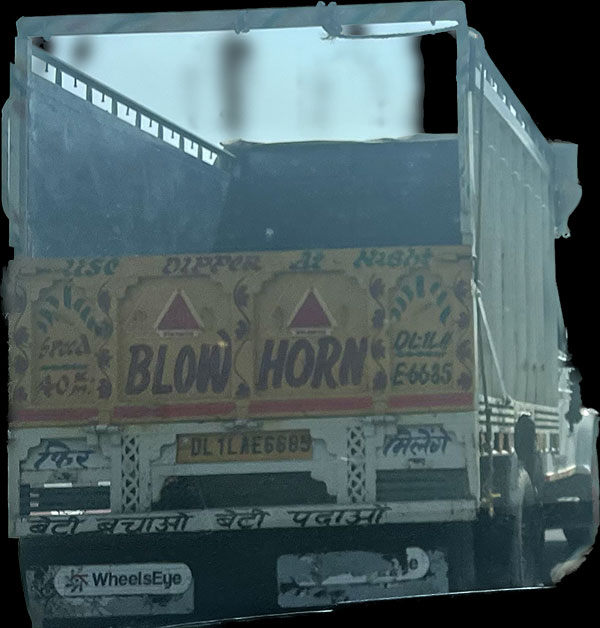
As we approached Varanasi from the airport, the roads and the city gradually became more congested. Unlike U.S. cities, Delhi and Varanasi didn’t have many tall buildings. They retained their original character, and in Varanasi’s case, that character stretched back 7,000 years. Varanasi is among the most ancient cities in the world. The culture appeared relatively unchanged, except for the presence of motorized vehicles and that those who were more fortunate had cell phones. We said goodnight to Krishna, and Anup took me to get a snack of street food then through an alley to my hotel, Ganesha Palace. Once again, rain had been forecast for that day, but it never did.
This hotel was nestled deep within the bustling city of Varanasi. It was fortunate that I could sleep through almost anything because the constant sound of honking horns seemed like an unending symphony throughout most of the night! My room was basic yet suited me well. Anup left on his motorcycle, and I made my way to the hotel’s restaurant, the “1916 Restaurant and Café,” a separate business that I later discovered had received a five-star rating from TripAdvisor. There, I met my server, Suhail, and noticed that this was one of the few places where I encountered occasional white people, likely Brits.
The menu featured a mix of Indian dishes, along with pizza, Asian cuisine, and veggie burgers. Many restaurants in Varanasi are strictly vegetarian and lack liquor licenses. If they don’t have a license, you can’t bring your own alcohol. Naturally, beef was absent from the menu as cows are considered sacred here. Cows roamed the streets, often dodged by motor vehicles and feasting on the abundant trash. Their role was to provide milk, be worshiped, and protected.
This hotel’s restaurant did serve beer, so I ordered a Kingfisher. I also ordered a salad with cucumbers, tomatoes, carrots, and onions. Indians ate onions like we eat apples. I told Suhail that I knew little about Indian food and asked him to recommend something. He inquired if I liked spicy food, to which I replied, “A little bit.” Little did I know that “a little bit” meant quite a bit. Authentic Indian cuisine in India was different from any Indian or Thai food I had ever tasted, and I quickly grew fond of it.
For most of my time in Varanasi, I had breakfast and dinner at this restaurant, and Suhail was always there to choose my meal and provide exceptional service, far exceeding what you’d expect in America. A full Indian dinner with two large Kingfisher beers would cost ₹1100, about 13 bucks. I left $20, knowing it was a better tip than he was used to, but I expect the service would have been as good with little or no tip.
My hotel was a short walk from the Ganges River, which I would visit the next morning. This turned out to be one of the most profound experiences of my life. My phone rang at 5:00 AM, and Anup was waiting for me in the lobby. I was ready, and so was the sun, warm already, and providing brightening light. As we walked through the town center, I learned that no cars were allowed, yet the streets were bustling, requiring us to navigate around motorcycles, rickshaws, and people who seemed to consider bumping into each other a daily occurrence. Don’t expect anyone to give you space or say “excuse me.” While waiting in line, even at the airport, many had no qualms about cutting ahead. Most Indians let it slide, but I considered it completely unacceptable and stood my ground.
The pedestrian population appeared desperate for resources we take for granted. For them, this has been their way of life for thousands of years. As the only white person, I became a target for beggars, and I had to ignore their pleas. Their poverty had been exacerbated by COVID. Nobody knew how many millions of Indians had died from COVID, and Varanasi, being the most visited city in India, suffered a significant blow to its economy due to the pandemic. Visitors were the lifeblood of their economy, and the disruption still lingered.
As we made our way to the River Ganges, I was further astounded by what I witnessed. The river appeared a putrid brownish-gray, stretching about a mile to the far side. Primitive boats crowded our side, surrounded by a swarm of humanity, many either bathing or preparing to. It was shocking! Some were scantily clad, while others wore loose, sheet-like garments. Initially, I noticed people going waist-deep, but to my amazement, many were completely submerged. Some performed rituals by splashing the water vigorously on their faces, while others bobbed up and down. Some even filled their mouths with the water and spat it out!
We gingerly crossed over 15 feet of rickety, narrow platforms that raised us to the river’s surface until we reached the first boat. Thankfully, there wasn’t a strong odor, likely due to the monsoon season causing the river to flow swiftly. My bare feet in rubber crocs were getting wet, but I was relieved the odor wasn’t worse. Anup explained that the water level was on the high side, varying by 35 feet. He kept trying to hold my hand to steady me as we moved from boat to boat, fearing I might fall in, but I resisted.
After reaching an outer boat, Anup arranged things with the boat operator, and I took a seat. The operator started the motor with a somewhat loud clickety-clack sound. Hundreds of people crowded the river’s edge, but there were very few in boats. We began chugging up the river, passing ancient buildings mixed with some modern ones, some dating back over a thousand years.
We cruised for a few miles, observing people bathing at various points along the way. We even passed by a mosque, which prompted Anup to express his frustration about Muslims allegedly taking land from Hindus and Buddhists through violence. He praised Mondi, India’s Prime Minister, for taking a strong stance against such violence. Mondi was up for re-election in 2024, serving his second five-year term. Anup believed he would easily be re-elected, though at 75 years old, concerns lingered about his health.
Then, something I had only heard about but didn’t expect to witness: the cremation of a body on the shore. Emotionally taken aback, I watched this from our boat, as we were fairly close. This happened at two different places we passed, hundreds of bodies every day, 24/7, 365 days a year. Anup explained that this was a celebration of life, incorporating five of nature’s elements: sky, water, air, fire, and trees. I later learned that a death certificate was required for a body to participate in this honorable ritual. For families who couldn’t afford cremation, bodies were buried at various spots along the river, often to be exhumed by the high tide. This had been a significant health hazard, and in recent years, the COVID pandemic had exacerbated the situation, leading to a surge in bloated bodies turning up everywhere.


We circled back down the river, passing our starting point for a mile or so, before heading back up the river to where we had begun. With our boat ride complete, we navigate our way back on foot to the shore.
It was around 6:30 AM, and more worshippers were heading for their rituals. Anup expertly timed our return, weaving through the growing crowds, with more and more people wearing bright orange robes and traditional forehead markings. The markings were administered by servants along the way, and I joined in to receive this blessing.
Later that morning, we enjoyed a curd and fruit-based snack called a lassi at a century-old establishment called the “Blue Lassi.” It was a small, unassuming place, much like the others we passed in the narrow alleys of inner Varanasi, and like most such places, it looked rundown enough to make you question the safety of the food. However, I found the lassi to be delicious, all-natural, and, to my surprise, I later discovered it had a five-star rating on TripAdvisor.


As we savored our snack, a corpse wrapped in orange cloth passed by, carried by its bearers. I pointed this out to Anup, and he asked if I wanted to see more. I agreed, and off we went to the actual cremation site.
The closer we got, the more bodies we encountered. We reached the base of a large stone platform, and Anup asked if I wanted to go up. It felt awkward, as this place was so sacred and there weren’t many people up there, most being part of the ritual. Once again, I stood out as the only white person. Despite my reservations, I agreed, and we climbed up.
I asked if I could take pictures, and it was evident that Anup’s presence allowed me to experience and photograph this ritual up close. On my second day in India, this was the second time I experienced something that would leave a permanent and profound impression on me. It was a cultural experience on steroids.

As my trip went on, I learned that there was always family at the cremation, and that typically the son of those being cremated was oriented to handle all of the proceedings. I’m certain this must’ve been the son of the person being cremated in this video.
That day had been truly remarkable, and I had anticipated it would be washed out by rain as forecasted. Surprisingly, the rain never arrived during the day, but in the evening, it poured so heavily that I couldn’t even hear the honking horns.
LIFE CHANGING NEWS – 10:10 INDIA TIME – AUGUST 21TH 2023
That night at 10:10 PM India time, I got life-changing news. Our son Rick sent a group text to the immediate family asking, “You guys ready for a girl Citro later today?“ “What?”, I responded. “Isn’t she 3 – 4 weeks early?”. “5 weeks and yeah, we are aware. Haha ” “Well, I am ready when you are, or she is”, I responded. The rest is history. Finley Lynn Citro was born via C-Section on Monday, August 21st! As a precaution, little Fin had to be held in the hospital on oxygen for “A few days,” which ended up being 2 weeks. Certainly, Rick and Katie were tormented by this, expecting Finley to be home with them. I felt helpless being on the other side of the world, but even if I were in Colorado, there wouldn’t be anything Nancy or I could do. Rick and Katie kept under the radar while we all had to wait it out. This adventure unfolded in a way that far exceeded any of my expectations, but hearing that that tiny little baby, my only granddaughter, was not home with Rick and Katie was what I wanted to have happened most.


The next day was museum and temple day. On our way I watched some masons doing brickwork. I would like my tile installer friends to learn from their technique!

We visited Maharaja Banaras – an outside garden with temples and a huge standing Buddha statue. We also explored The Vidra Mandir Museum – a large 200-year-old fort on the River Ganges, and The Archaeological Museum featuring sculptures dating back as far as 2000 years.


This experience reminded me of why I’m not a fan of “tours” that require you to stay with a group. Aside from the fact that the architectural museum was air-conditioned, none of it piqued my interest. I’m willing to bet that many museums in New York City would have far more to offer. I shared my thoughts with Anup, and we decided to call it a day. We headed back to my hotel’s air-conditioned room around 1:30.
Anup holds the temple and Hindu aspects sacred due to his strong Hindu upbringing. He’s proud of his beliefs. He explained that sculptures that were damaged, many with broken noses, were allegedly desecrated by Muslims. We also discussed his appreciation for the US involvement in fighting the Muslim Taliban in Afghanistan, our 20-year-long war. I told Anup that it was time to pull out; America had had enough. But Anup continued to encourage me to embrace his Hindu/Buddhist teachings, knowing it aligns with my philosophical beliefs.
I asked him about the influence of the Beatles and how they, despite being British, played a role in reuniting with India in their music. I’m thinking “Within you Without you” from Seargent Peppers. The Beatles came to India, as I did, to embrace the culture and seek inner peace. They also promoted the Transcendental Meditation movement and practiced with its leader, Maharishi Mahesh Yogi. Surprisingly, Anup had never heard of “The Beatles”!
When exiting the museum, Anup had me wait while he went to get our driver. Meanwhile, I observed a man pushing large sticks into a noisy contraption. Liquid was coming out from the lower end, and it was being poured into cups and sold. Confused, I asked a well-dressed Indian man nearby, and he explained it was sugarcane juice. He bought two cups and treated me to one. In gratitude, I drank it and gestured my approval, although I secretly thought it tasted like sweet warm dishwater.
Ever since arriving in India, I still hadn’t adjusted to being 9 ½ hours ahead of Eastern time. I often found myself crashing out by mid-afternoon, having dinner around 8 – 9 in the evening, and struggling to sleep until morning, all contributing to “Rich Citro’s South Asian Adventures.” Now, it was TAJ TIME. Initially, I considered skipping the Taj Mahal when planning this trip, thinking it might be an undesirable tourist trap. However, it is one of the 7 manmade wonders of the world, and I knew I wouldn’t be coming back anytime soon. Anup had planned for us to drive 9 hours there and nine hours back
I was content with my situation; the entire back seat belonged to me, equipped with Netflix movies downloaded, a book, time to contribute to “Rich Citro’s Asian Adventures,” and space to crash. However, I soon discovered we were susceptible to a different kind of CRASH. Indian highways are a unique form of chaos. They drive on the left side of the road here, and the lines on the road might as well be imaginary because they are virtually ignored. Incredibly, vehicles have no qualms about stopping anywhere on the highway, including the middle, or even driving in the opposite direction in the left lane!
At one point, we needed to turn around, and Krishna pulled into the left lane, backed up a quarter-mile, and careened across three lanes, executing a U-Turn over the median! But that’s not all that made the journey interesting. Cows, dogs, and monkeys frequently cross the road. They seem to know the pecking order because the dogs and monkeys proceed with caution, often running but cows know they are protected and lounge around lazily. Some cows even choose to lay down smack in the middle of the highway!
Adding to the challenge was the rain. I had planned this trip during the monsoon season to avoid other tourists, and as luck would have it, I remained dry for all of my outdoor adventures so far. But on this drive, the heavens opened up and the rain pelted our vehicle. Krishna was up for the task, and we arrived in Agra that night safely. I wanted to see the Taj Mahal at night, but I learned that this option is only available five days a month during the full moon.
We dined at the hotel restaurant, which was also vegetarian and had no beer. After that ride, a few beers would have been welcomed, but instead, we raised our water glasses to Krishna, “The Best Driver in All of India!”

 Rich Citro Adventures