The adventure got especially interesting when I tried to get back to the hotel from the Pyramids. The first two Uber drivers insisted on being paid in cash as we navigated the broken, chaotic streets. I refused both times and asked them to pull over so I could get out. Each time, I was dropped off in areas that would likely terrify most Americans.
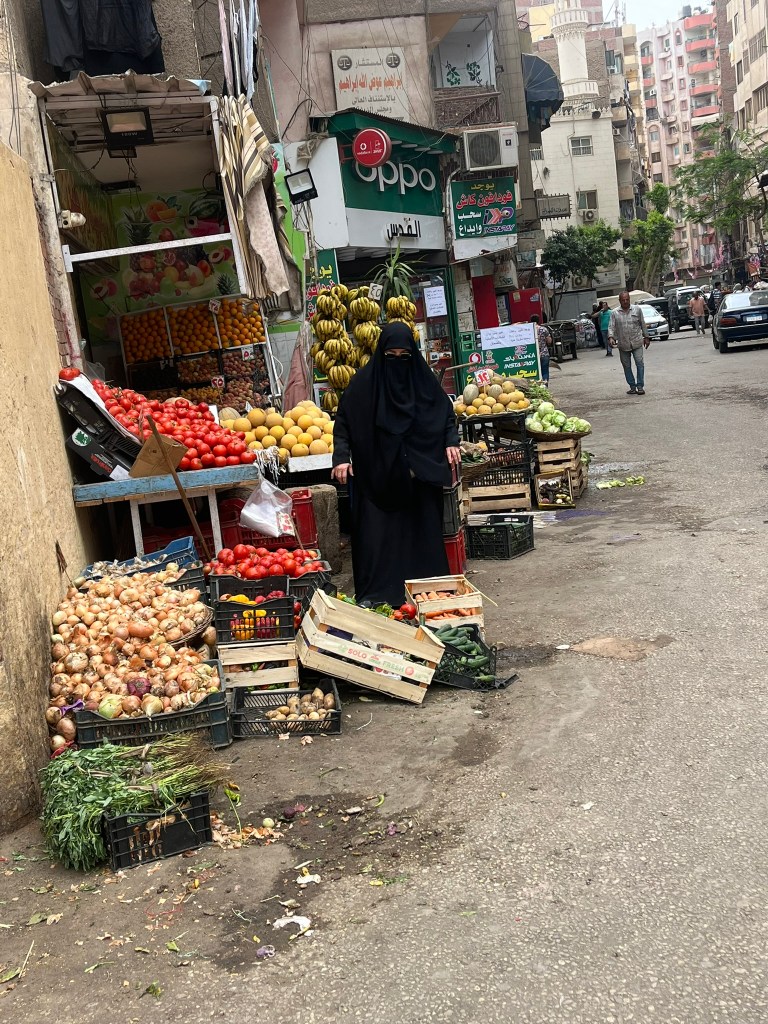
While waiting for another Uber, I discreetly snapped a photo of a woman in a full burka, making sure she didn’t see me take it.
Getting back to the hotel from the Pyramids was an adventure. Two Uber drivers demanded cash, so I had them drop me off—each time in rough neighborhoods that would unsettle most Americans.
On my third attempt, an Uber driver finally pulled up. Using a translator app, I negotiated with him directly. We agreed on 600 EGP—about 12 bucks—and I canceled the ride through the app. I’m learning!
I felt a wave of relief returning to the Hilton Grand Nile. Having just come from an area of extreme poverty only 30 minutes earlier, the contrast was jarring—a stark reminder of how deeply our lives are shaped by circumstance.
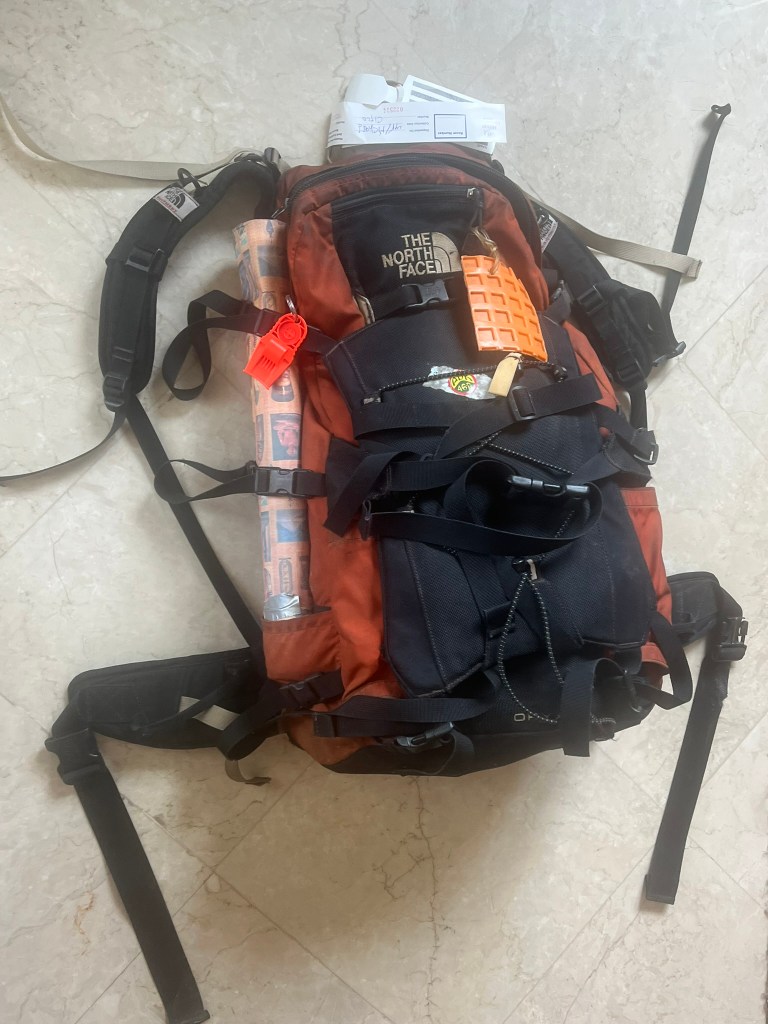
That night, I decided to head to Luxor on a sleeper train. Luxor—formerly known as Thebes—was once the greatest city in the world, with a history stretching back over 5,000 years. I set out with my backpack, ready for the hour-plus journey to the train station.
As I walked, I realized the biggest danger on this trip wasn’t scams or theft—it was traffic. Much like my experiences in India and Vietnam, cars honked constantly, there were no crosswalks or traffic lights, and any painted lanes were completely ignored. Walking around was scary and dangerous!
At one point, I had to cross a busy highway, with cars flying by in both directions. I stood there for a while, unsure of how to make it across. A man nearby pointed to a path on my right and said something in Arabic. I don’t remember exactly how I responded, but he replied in surprisingly good English. Noticing my head covering, he laughed and said, “I thought you were Egyptian!”
He told me he had spent two years in Los Angeles as an art student and kindly guided me to a safer route through the highway underpass. Just as we were about to part ways, he pointed to a small gallery and said, “My art studio is right here—I’d love for you to stop in.”
I was ready for a break and this was the first English conversation I’d had since arriving. I was actually interested in buying some Egyptian art, though I wasn’t keen on carrying anything this early in my trip. Still, I agreed, thinking it might give me a sense of local pricing and that it would be an opportunity to learn something.
His studio turned out to be a charming little shop. He introduced me to his sister, who also spoke some English and immediately brought me a cup of tea.
He showed me a table with about eight paintings, proudly announcing that they were all his original works. Then he said, “I’d love it if you would accept one of these as my gift to welcome you to Egypt. It isn’t always about money.”
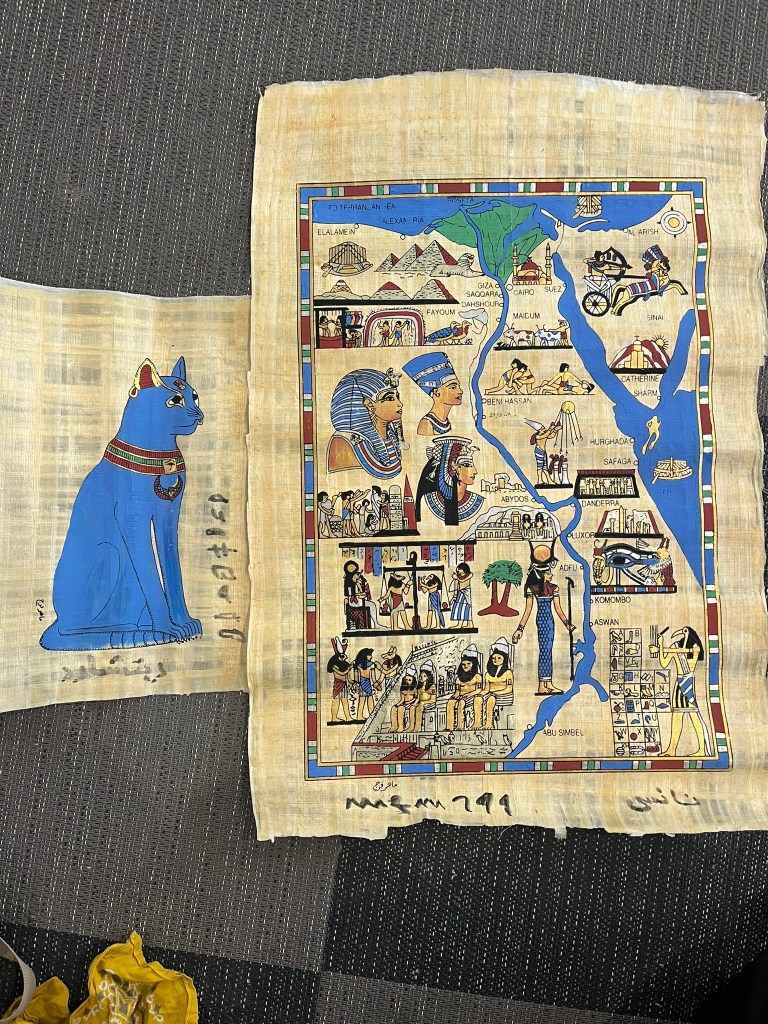
I hesitated, but he was quite persistent. I pointed to a painting of a cat that I liked, saying I’d give it to my wife. He asked her name, and when I told him, he handed the piece to his sister, who painted Nancys name on it in Arabic.
At that point, it still felt like a fun and spontaneous experience—until I thanked him and stood up to leave.
He told me we’d have to wait for the paint to dry before rolling it up, then began laying out a variety of larger artworks on the floor. “Why don’t you pick another one?” he said.
It was only then that I realized this could be a scam, but I continued to play along.
I said, “They are too big, There’s no way I can carry this artwork—I’ll be traveling with just this pack for the next eight days.” In response, he grabbed one of the pieces, crumpled it into a ball, and then let it go. It bounced right back without a wrinkle. I was genuinely impressed, though by then I knew where this was going.
Still, I really liked one of the pieces—it was a map of Egypt highlighting the places I planned to visit. He handed it to his sister, who painted my name on it. Naturally, that had to dry too.
We chatted for a bit about his time in the U.S. and my travel plans in Egypt. I wasn’t in a rush, but I was starting to feel impatient. I finally stood up and said, “I really must go. I need to get to the train station.” She had the artwork rolled up in a package and placed it on the table between us.
That’s when he said, “You realize these are very valuable gifts.”
I replied immediately, “And it’s a wonderful welcome—that I’d get them for free.”
He gave me a sour look. “But these are valued at well over $100!”
I reached into my wallet and took out four 200 Egyptian pound notes—about $16 total—and placed them on the table beside the package of artwork.
I said, “But this has now become business. You can keep the artwork or take the money.”
I’ll never know if this was a coincidence, if he set a trap as soon as I open my mouth, or how satisfied he was with the transaction, but even though I now had something else to carry, I was pleased.
Finally, a third driver agreed to take me for 600 EGP (about $12) after I negotiated directly using a translator app. I canceled the ride through the app—lesson learned.
Returning to the Hilton Grand Nile felt surreal. Just 30 minutes earlier, I’d been surrounded by poverty. The contrast was striking.
That night, I headed to Luxor by sleeper train. Formerly Thebes, it was once the world’s greatest city. I set off with my backpack for the station.
Navigating Cairo’s streets, I realized the real danger wasn’t theft—it was traffic. With no crosswalks or signals, and cars flying in all directions, crossing roads was terrifying.
At one point, I froze at the highway. A man pointed out a safer path and, noticing my head covering, chuckled, “I thought you were Egyptian!”
As I crossed under the busy highway, the man who’d studied art in Los Angeles helped guide me through an underpass. Before we parted, he invited me to visit his nearby studio. Craving conversation and curious about local art, I accepted.
The studio was cozy, and his English-speaking sister offered tea. He showed me a table of paintings, saying they were all his originals. “I’d love for you to accept one as a gift,” he said. I chose a cat painting for my wife, and his sister personalized it in Arabic.
It felt warm and genuine—until he said we’d need to wait for the paint to dry and began laying out larger works. “Pick another one,” he urged. I realized I might be in a scam but played along.
When I said I couldn’t carry large art, he crumpled one, showing it was wrinkle-proof. I liked a map of Egypt he had, and again, his sister painted my name on it.
Eventually, I said I needed to leave. As she packed the art, he said, “You realize these are very valuable gifts.” I replied, “And it’s a wonderful welcome—that I’d get them for free.”
He pushed back: “These are worth over $100!” I calmly placed 800 EGP (about $16) on the table. “Then it’s business—you can take the money or keep the art.”
Whether it was a setup or just cultural haggling, I left satisfied—with stories and souvenirs in hand.
I continued my walk to the train station, reckoning Cairo to be similar to my other experiences in India or Hanoi. No crosswalks, no stoplights, cars beeping their horns, constantly, and ignoring any of the lines on the road where they existed.
Finally at the train station I paid $90 for the 9-hour trip and chose to save $30 by agreeing to share the cabin with a stranger.
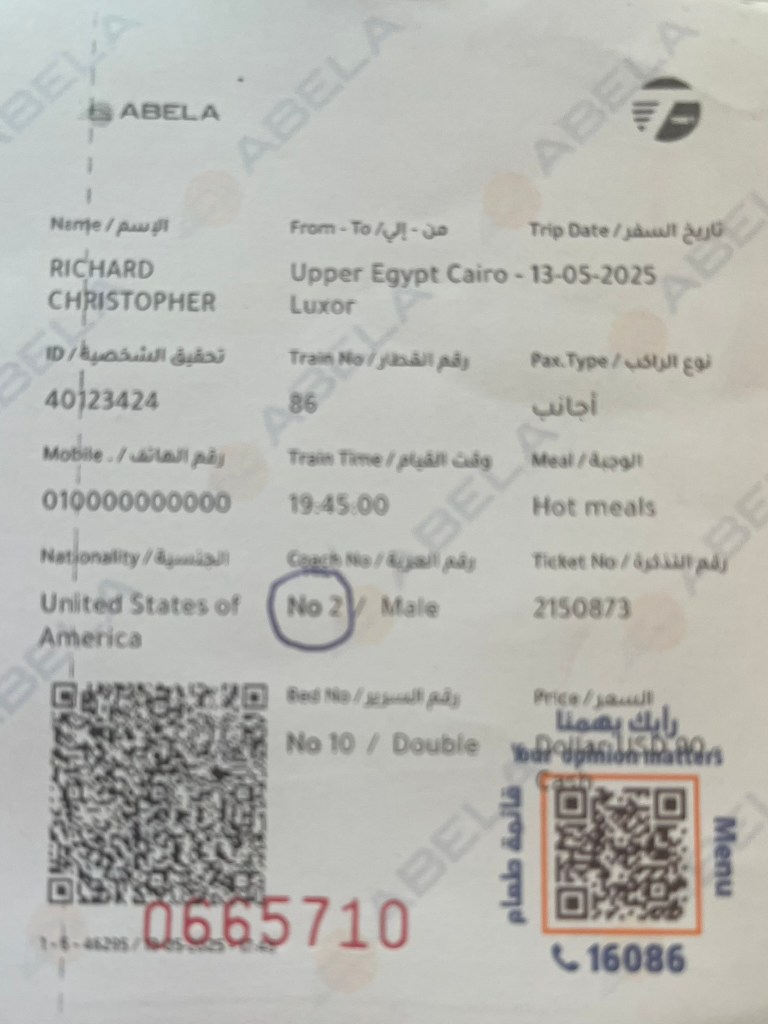
Just when I thought I was all set, the ticket officer informed me I needed to go to the Giza station—another hour’s walk away. Knowing how rough the streets of Giza are, even compared to Cairo, I made the smart decision and grabbed a cab.
“How much?” I asked the driver.
“Depends on meter,” he said.
I turned and began to walk away.
He quickly called out, “$15 U.S.”
“OK,” I replied, “But no bullshit!”—a language everyone understands.
“OK!” he agreed.
A few minutes into the ride, we hit traffic.
“Too much traffic. Twenty-five,” he said.
“Fifteen!” I shot back.
“No!” he insisted.
I reached for the door as if to get out.
“Twenty!” he countered.
I began stepping out.
“OK, OK! Fifteen!”
And off we went. I’m definitely good at this!
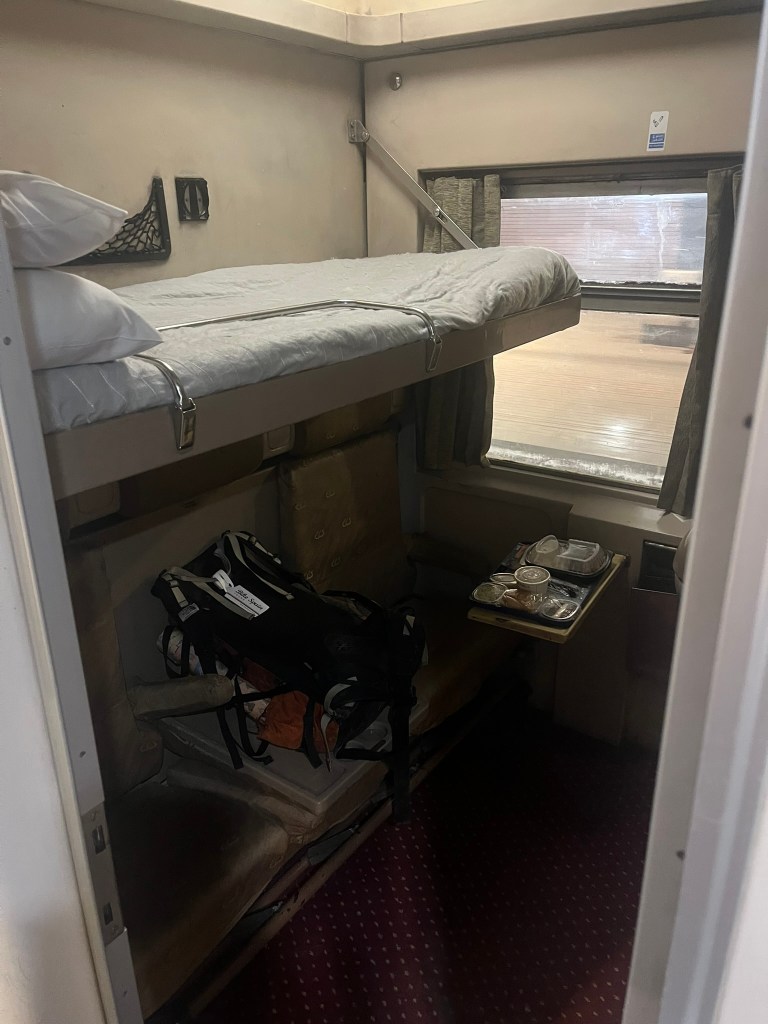
I arrived at the train station with plenty of time to spare, but it was nowhere near as nice as Ramses Station. Still, it was a cultural experience in its own right—most of the passengers were locals. My 7:45 train finally arrived sometime after 9:00. I boarded, found my cabin, and waited for my roommate to show up.
To my delight, no one ever did!
Just as I thought I was set, the ticket agent told me I needed to depart from Giza station—an hour’s walk away. Knowing how rough Giza’s streets are, I hailed a cab.
“How much?” I asked.
“Depends on meter.”
I walked away.
“$15 U.S.!” he shouted.
“OK—but no bullshit!”
“OK!”
A few minutes in, we hit traffic.
“Too much traffic. Twenty-five,” he said.
“Fifteen,” I snapped.
“Twenty!”
I reached for the door.
“OK, OK! Fifteen!”
I arrived at Giza station with time to spare. It was far rougher than Ramses Station, but offered a glimpse of local life. My 7:45 train showed up after 9:00. I boarded, found my cabin—and lucked out: no roommate.
 Rich Citro Adventures