HAVANA CUBA
Wednesday October 30 2024.
There’s a little-understood place in this world just 90 miles from our United States border that was once an exciting tropical getaway. Clean and beautiful with luxury accommodations and everything you would hope for on a great vacation. It was so wonderful that many Americans even chose to make it their home. Central to this place was an iconic city that was once the envy of much of the world. The place I refer to is an island about the size of Florida, called Cuba, and the city is Havana. If you have heard that this island is on the verge of collapse, don’t believe it. It already has collapsed. So, I decided to go. A week before my arrival, the electrical grid for the entire island had failed for everyone for 3 days. That made me more determined to get there.
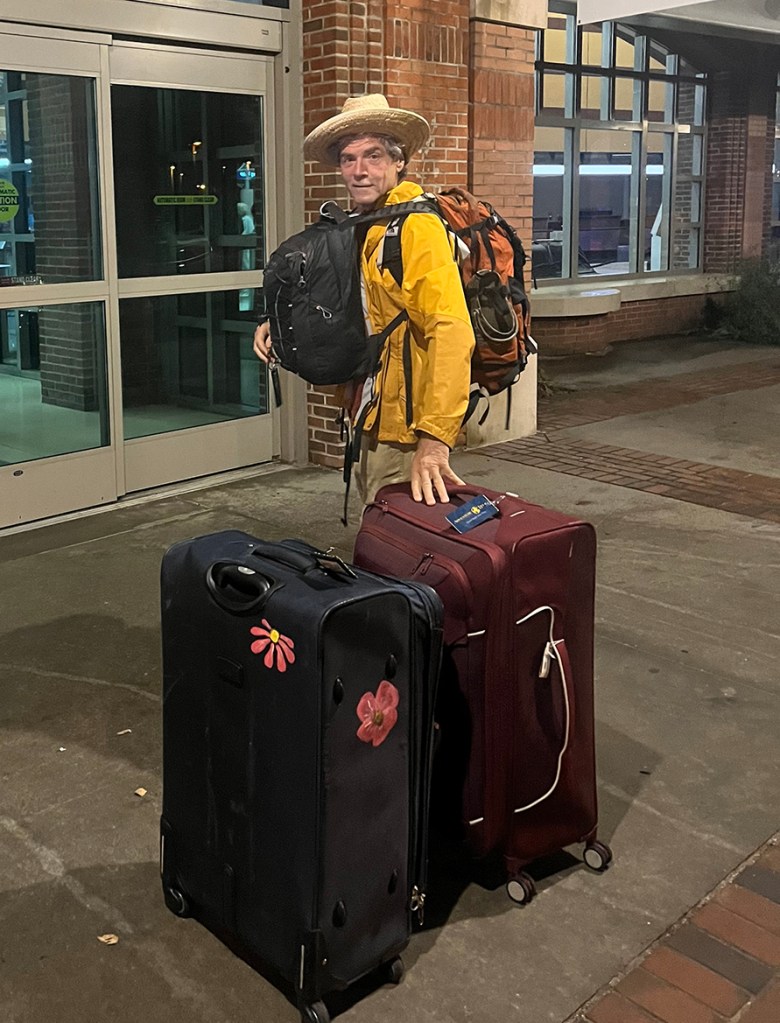
I was carrying two large suitcases, a carry-on, and a personal item, totaling about 175 pounds (80 kg) 140 of which were gifts to help Cuba’s impoverished souls. American Airlines charges $30 for your first bag and $150 for your second bag, and they were not to exceed 50 pounds. I learned that if you had just one flight booked as first class, you could get your first two checked bags for free, and that they could be as much as 70 pounds! I changed my flight from Albany to Washington to first class for $65 and was ready to travel with far more luggage than I ever had in my life. My flight from Albany was at 5 AM. The two free Bloody Marys in first class were helpful in preparing me for my journey.
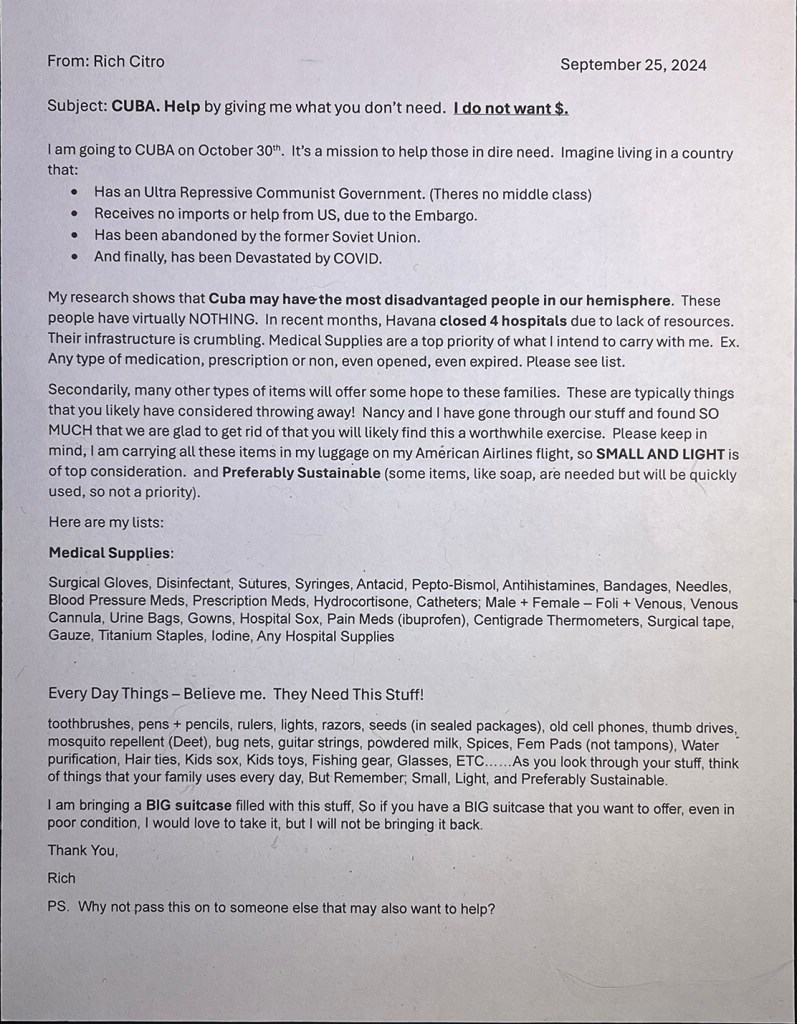
My large maroon checked bag was loaded with medical supplies donated by many of Nancy and my friends, mostly with medical backgrounds. Medical resources are in desperate need for the entire island. My other bags were loaded with a long list of just about everything that we take for granted every day. A year ago, Cuba had a population of 11 million, but they are now down to 10 million because about 10% have left. These were mostly younger families, so what remains is a disproportionate number of old and elderly. I sent a letter to about a dozen friends that described what’s going on in Cuba and how they may help. I’m happy to say that they came through well beyond my expectations. There are a multitude of reasons why the Cuban people have been left behind, and some of them are in the following letter, but you might find it worthwhile to do some research because from what I can see, most Americans have no idea about a true tragedy so close to our home. What’s going on there was not the fault of the wonderful people of Cuba. Here’s my letter:
The airport was among the worst conditions of any that I have ever been through in my world travels, and I had concerns with immigration. Only two luggage scanners were working and one failed, leaving our huge line to pass through their only operating scanner. This is an oppressive Marxist-Leninist regime and I was carrying prescription medications and such a wide variety of electronic, electrical, and other supplies that I expected they would find something they didn’t like. But my carry-on bags went through their scanners, and after collecting my two huge checked suitcases, I strolled through immigration after a momentary stop to check my passport. Then another representative held me near the exit, seemingly waiting for assistance. But when no one showed up, he let me pass. Their airport infrastructure was clearly disorganized.
I had arranged with my Airbnb to be picked up by Julio. He was supposed to be waiting for me outside with a sign. The first thing that hit me was the 85° heat as I walked out of air-conditioning for the first time that day. I waited and wondered for about 20 minutes until Julio showed up. He had a picture of me and my luggage so when he finally arrived, he found me easily. Julio was driving a Mercedes that was among the newest and most modern cars that I had seen in the 20 minutes that I was waiting for him. I later learned that Julio is an anesthesiologist who got off a bit late from his shift.
He drives a taxi during the day because he has a nice car and taxi drivers are paid more than any occupation in Cuba. Doctors get paid about $60 a month now, about the same as an American doctor can make in about 20 minutes. This is particularly because the hospitals have little to no resources to do their job. The reality of my humanitarian mission was apparent as we made our way to my Airbnb. One thing that stood out was a lot of the classic American cars. Mostly convertibles, brightly painted, often pink or purple, and most of them from the 50s. It seemed quite odd as most of the other surroundings were that of desperation, but at that point, I didn’t realize that it was going to get a whole lot worse. It became clear that the government did their best to clean much of the trash going from the airport to their government-owned resorts. Once I arrived in the side streets of Havana, the abundance of trash heaps and crumbled buildings was beyond imaginable. I later learned to never seek shade under any type of balcony because they had a reputation of collapsing above you.
About a half-hour later, we arrived at my Airbnb and I met Andrew, my host. I was his only guest and he helped me with my load up the 2 flights of stairs. My room was about 7,000 pesos a night – 21 bucks. It was all that I needed, but turned out not to have hot water for the six days that I was there. After being outside in the heat, a cold shower suited me OK. If I had power, which allowed me to turn on the AC, I would often relax in my room and work on this documentary, but as days passed I discovered how profoundly poverty-stricken many of the people were. Experiencing that, I decided not having hot water was nothing to complain about.
After I reorganized everything in my modest room, I sat with Andrew on his veranda with a few beers. While chain-smoking, Andrew filled me in about the many things that I was curious about, including telling me a bit about himself. Now separated from his wife, Andrew replied to my curiosity as to what the hell he was doing here. He’s a citizen of Toronto with perfect English, and this is one of the reasons why I chose his establishment. He has been living here for seven years while his Cuban wife and her son switch places with him and are in Canada. I liked him immediately because it was evident that he was happy living a very modest life among these bare necessities and didn’t appear to be offended by being surrounded by these atrocious conditions.
I then explained to him that I was meeting a doctor the following day for whom I was going to offload my huge maroon suitcase of vital medical supplies. Everything has been communicated on the Internet, with contacts established through Facebook, so naturally, I was suspicious and asked if there was a way he could vet the doctor that I had planned to meet. I told him the doctor’s name and he didn’t have any way to check him out. The contacts I was working with instructed me not to reveal the doctor’s name on anything other than on WhatsApp, which is encrypted. If the government found out that I was passing out this large quantity of medical supplies, it could get this doctor in trouble and they could confiscate them. For that reason, all names in this story have been changed. I showed Andrew some of my conversations with the doctor on WhatsApp, always translated as the doctor knew no English and I knew no Spanish. I decided to send the doctor a message then, via WhatsApp, and he got back to me right away. He said that we could meet at 8 the next morning because he would be working all night in the hospital. I actually chose this Airbnb because it was close to his home and the hospital where he worked, so it was confirmed that he would come to my Airbnb at 8. Andrew agreed to be there to help interpret.
I offered to take Andrew to dinner and we walked a few blocks to a nice restaurant offering authentic Cuban food. This restaurant had an owner from Iran. We both ordered the lamb and liked it. He chain-smoked the entire time, enabled by the fact that a pack of Cuban cigarettes only cost 200 pesos – 70 cents. Our dinner conversation turned out to be a great way for me to learn many details as to why Cuba continues to deteriorate and I got an idea of what I was about to experience over the next five days. As bad as the situation got in Andrew’s seven years here, he remained somehow upbeat. We got back to my room and I slept well having been up since 3 AM. Cuba is in the same time zone as NY. I was also learning that in Havana things start late in the evening and stay open well into the next morning.
Thursday October 31st
I met Andrew on the veranda the next morning for coffee. I asked him if decaf was “a thing” here in Cuba and he made a face, shaking his head in the negative. I expected that and brought my own. The doctor showed up on foot at 8 o’clock wearing his scrubs and what appeared to be some kind of medical device over his shoulder. I was encouraged. We brought him up and into my air-conditioned room as the heat was already beginning to make it uncomfortable. I opened the big maroon case and started to display and explain the items in English. Andrew would interpret as the doctor shook his head approvingly. We brought the case down the stairs, gave each other a hug, and off he went. He messaged me the next day, informing me of how he had already begun to use many of the supplies.
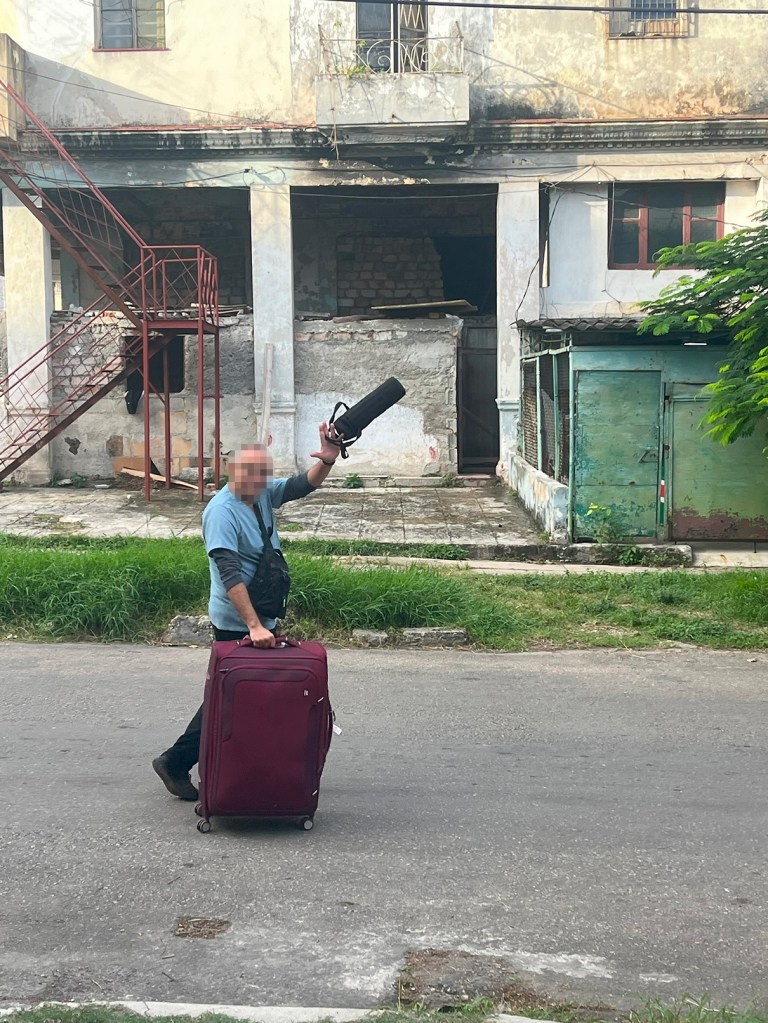
Now feeling very good about the way this went down, I invited him again two days later and gave him another quantity of various medical supplies. Google Translate was a huge benefit for our communication over WhatsApp, and we continued interacting for the rest of my time in Cuba and to this day. I was able to learn more about what he wanted and needed and I was humbled by his degree of appreciation. He was blunt and frank about how terrible things have gotten and attributed it all to the failure of his government. On his second visit, I also included disinfectant, flashlights, chargers, rechargeable batteries, and battery testers. He particularly liked the headlamp because of power outages in the hospital during surgery. I also gave him fishing gear because he told me that he had a passion for fishing as it helped him relieve the stress from his high-pressure job. I also passed along four types of water purification systems. I was warned to only drink bottled water and to listen for the clicks when you twisted off the top because scammers would take used bottles and fill them with tap water to resell them as new. It was a great meeting and we gave each other a hug as he headed out to begin a 24-hour shift.

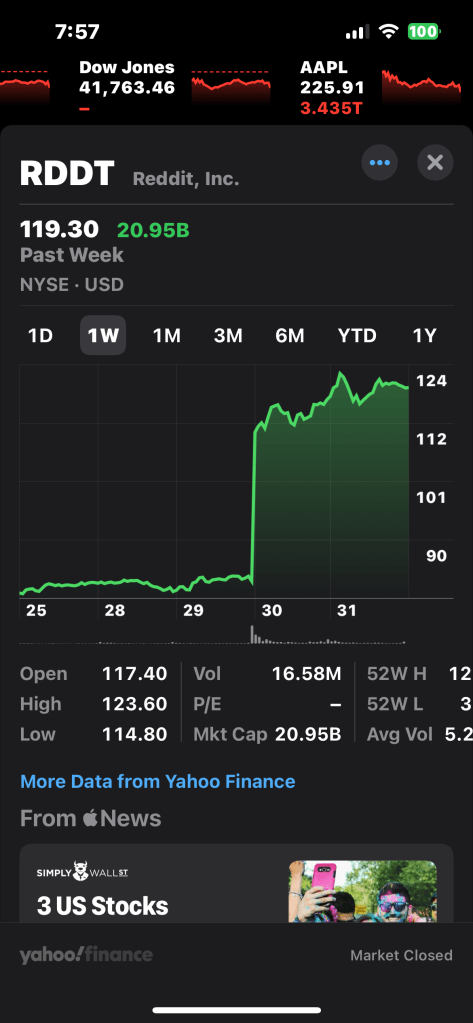
Taking on such a mission at one’s own expense is certainly a deterrent, but I believe in karma and sometimes things happen for a reason. I decided to do this adventure a few months ago, and I got much of the information from Reddit. I used Reddit to plan this trip and concluded that there was nothing like it in the world. Reddit went public just before I left. I don’t own Any individual stocks right now but I decided to buy. After my meeting with the doctor, I clicked on my app to see what was going on in the news. My Reddit stock had skyrocketed during my meeting with the doctor! From that moment on, the trip was more than paid for!
Back to my first day there, my plan was to rent a bike that was prearranged with a vendor with a private business just a few blocks away. Google Maps got me to my destination, but this was a residential area. I was finding that Google Maps didn’t always work well here because the street numbers were so botched that they didn’t always correspond to the map. Another difficulty was that you never knew what street you were on because there are no street signs. I asked a black man in his 20s who was walking by and said, “Rental bicyclette?” It became obvious that he did not know the area, and that my Spanish was nonexistent. He then started asking other people until the third person he asked pointed to an open gate. I then saw a wooden ramp that went up the side of a flight of six stairs to a residence. I gave the man a wave of thank you and got my first confirmation of something I had read about and hoped to find in Cuba. As desperate as their situation had become, the Cuban people are a good people who care enough about one another to lend a hand. I found this to be the case everywhere I went.
I went up the stairs to find a partially opened door with two letter-sized pages taped to it. One said in English, “Bike Rental, Ring Bell” and the other had a phone number. Both messages were scrawled out with a black magic marker. I rang the bell and waited. I didn’t hear anything so after a while I began knocking and calling out, “Hello,… Hola!” Eventually, a man showed up. He apologized and in his broken English explained that the bell didn’t work because the power was out. This is something that I would learn would be a routine thing for my entire visit. Some rural areas of Cuba now only have power for a few hours a day. As a result, they can’t refrigerate food. I still don’t understand how they survive under these conditions, and learned that some do not. His name was Frank and he was from Barcelona. His English was good enough for us to get through the endeavor and he explained that he had been waiting for me. It was obvious that I was probably the only customer he would see that day, or possibly that week. The previously agreed rate was $10 a day so that 50 bucks was a blessing to him. The bike was clearly substandard but had gears and that turned out to be helpful because there were hills and a very strong wind the entire time I was in Cuba.
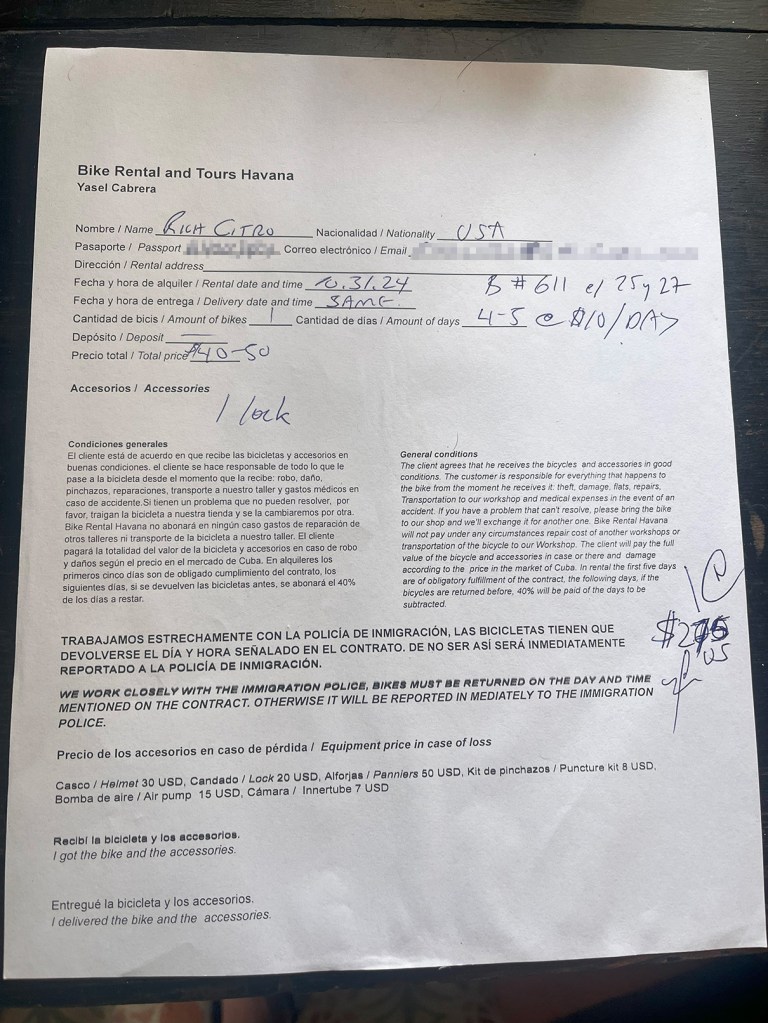
He provided me with a lock and key, but made it clear that I should never leave the bike alone. Our rental agreement included a stipulation that any loss or damage would be my responsibility. I insisted that we handwrite the value of the bike in case it got stolen. We agreed on $275. We discussed the fact that there would be places where I would want to go inside and could not bring the bike and I asked him how I would deal with that. He asked, “Did you see any bikes locked up since you’ve gotten to Cuba?” I said no, and he said, “That’s because if they were, they had gotten stolen.” He then said that I would see government officials in most places and that they were easy to identify with their red hat and vest. I was to leave the bike with the official and then give him a few pesos when I returned. I learned that these officials were only found in government locations, the places I was specifically avoiding, so if I went to a place that I couldn’t bring the bike in with me, I simply would not go.
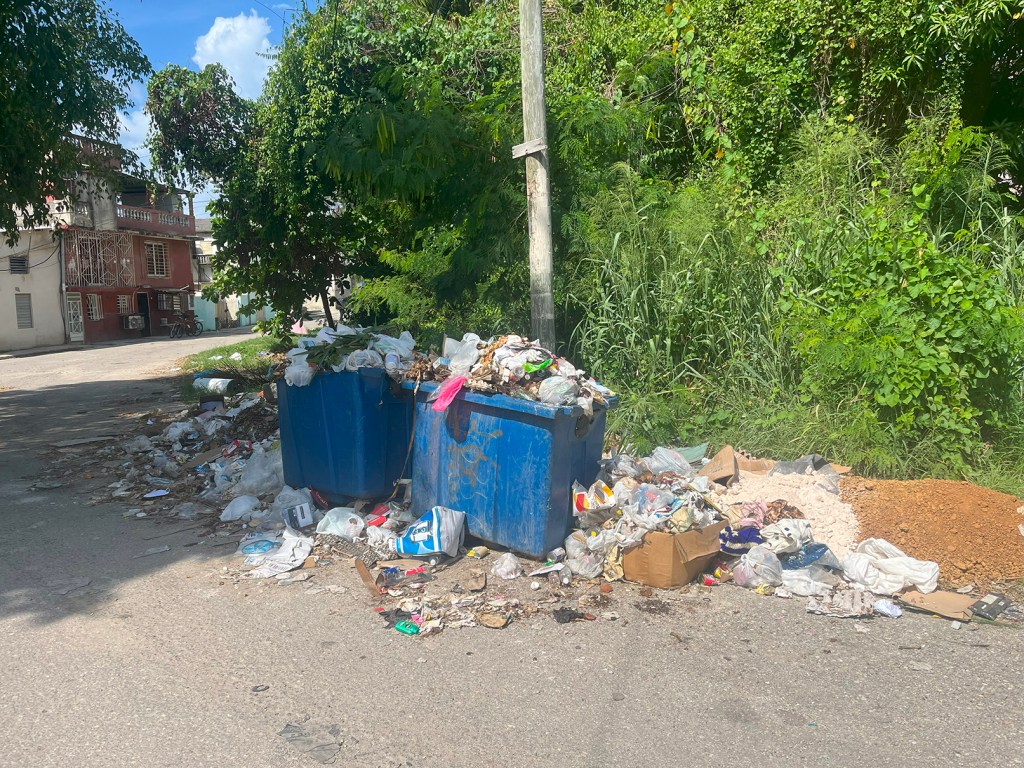
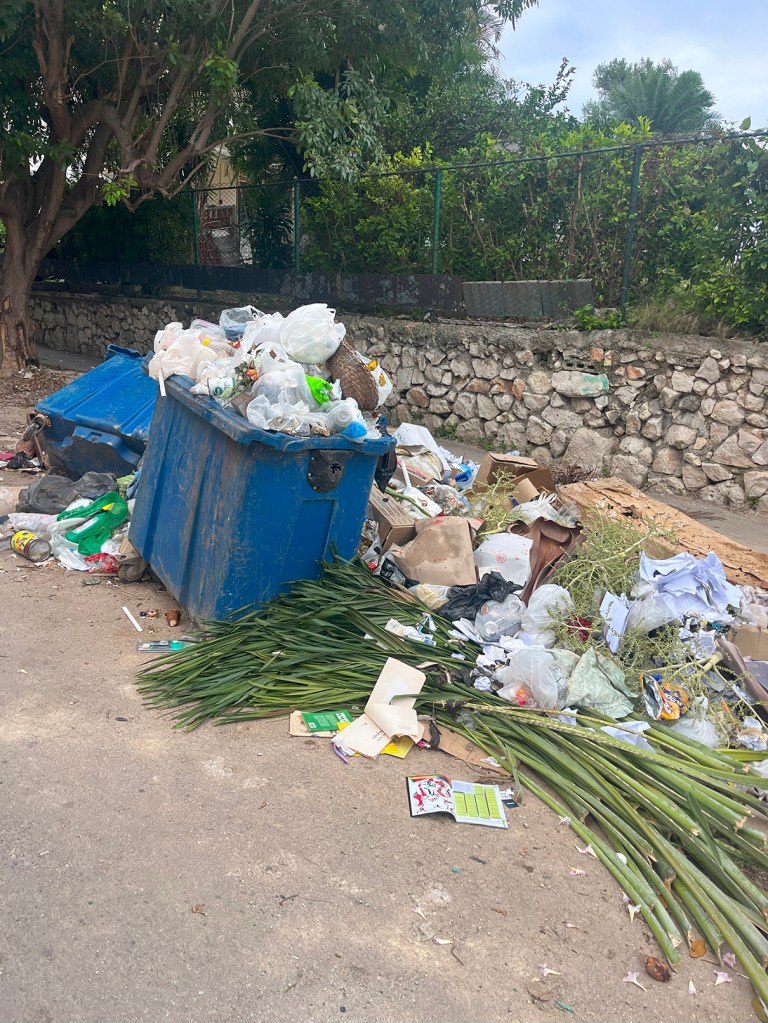
So now I was off! I headed towards the ocean, which was about eight blocks north. I tried to stay on streets less depressed, but other than the occasional nice home, the area was pretty much broken down. There were huge heaps of trash on many corners, some with people sifting through. It was hot, but fortunately windy, so I tried to steer upwind of the stench that the trash piles emitted. The massive heaps of trash and stench were so common that they had an unexpected purpose for me. Most of the buildings looked pretty much the same, and again, there were no street signs. So the unique configuration and the intrusiveness of the trash heaps were identifiable enough to use them as landmarks.
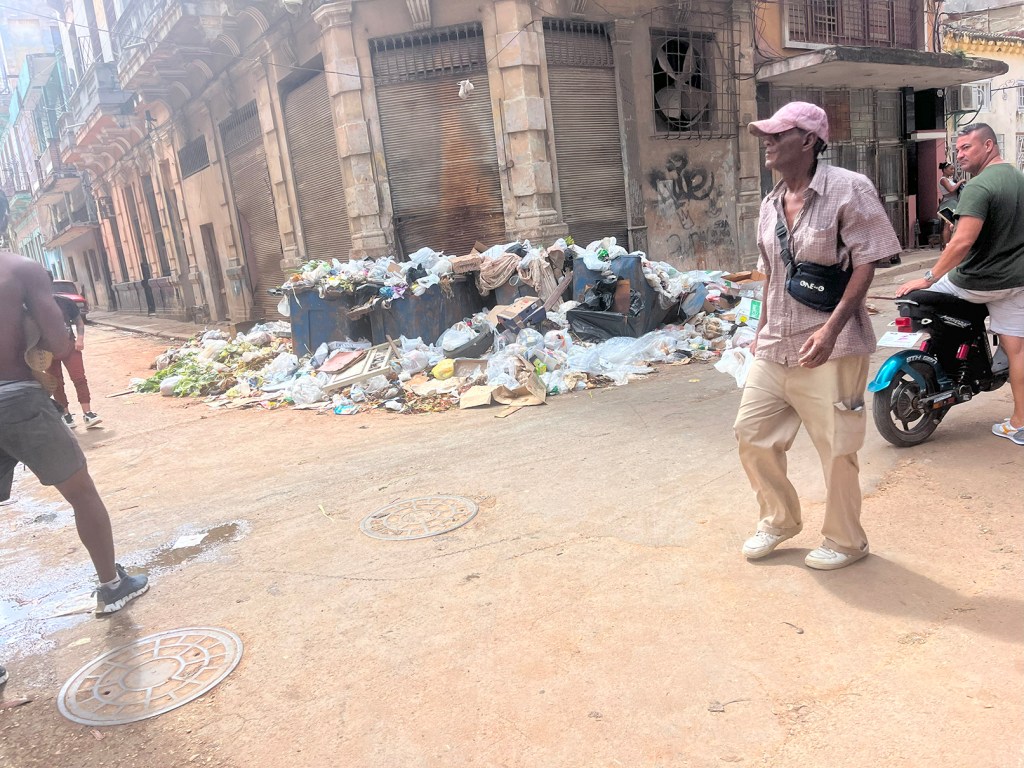
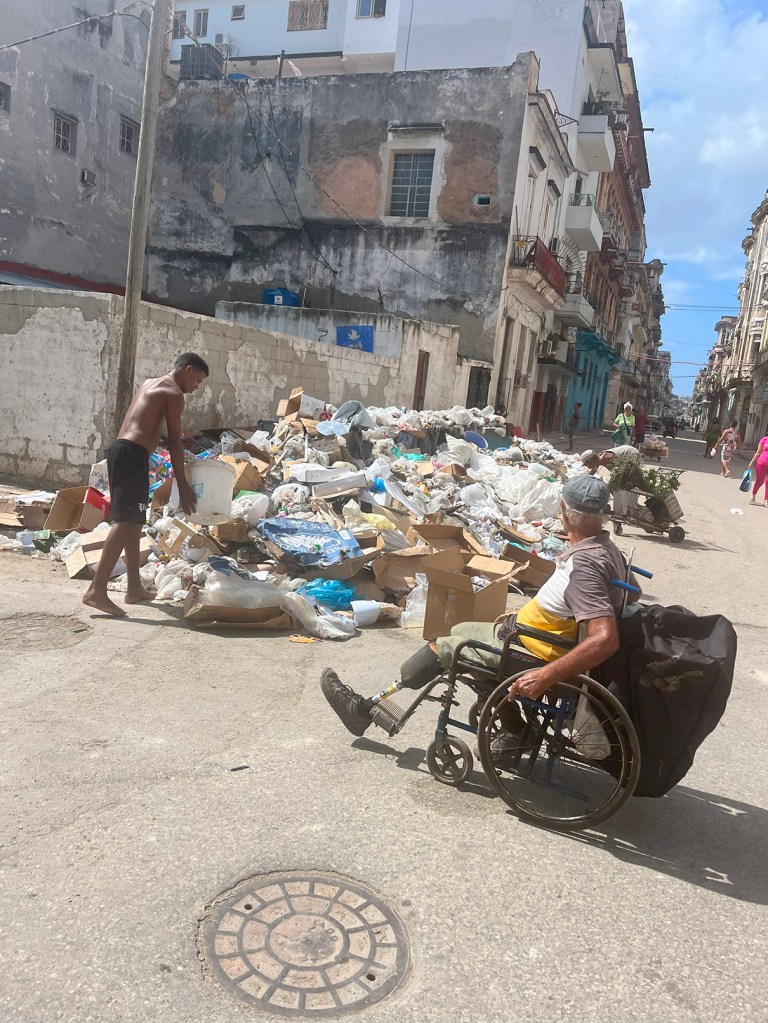
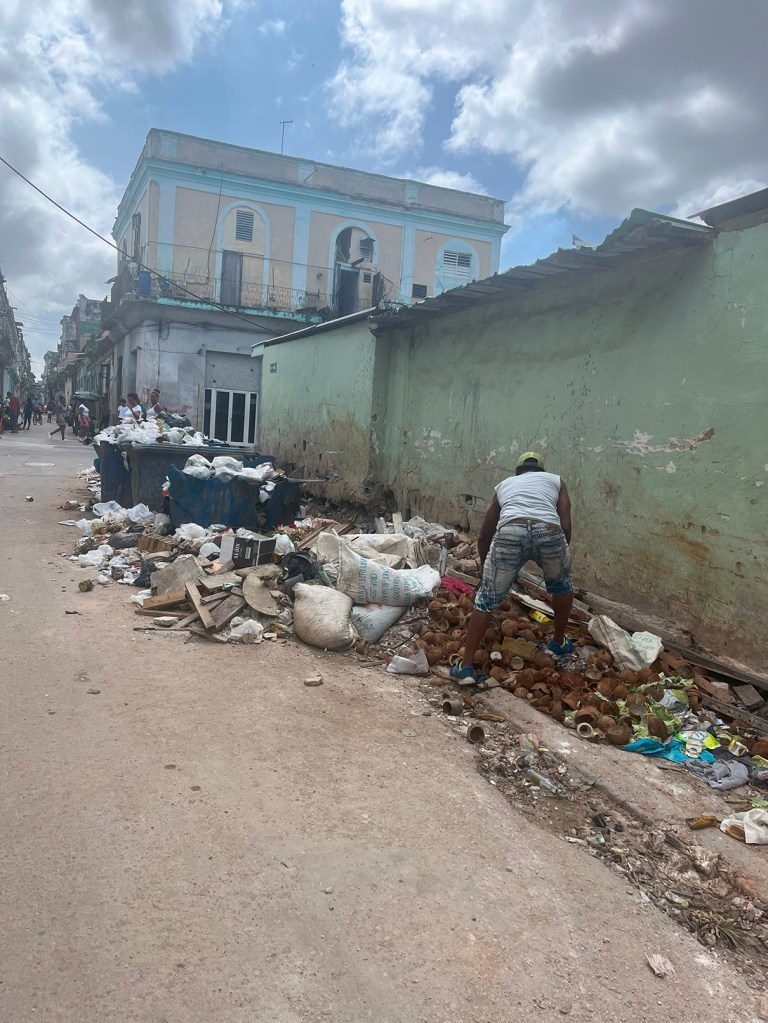
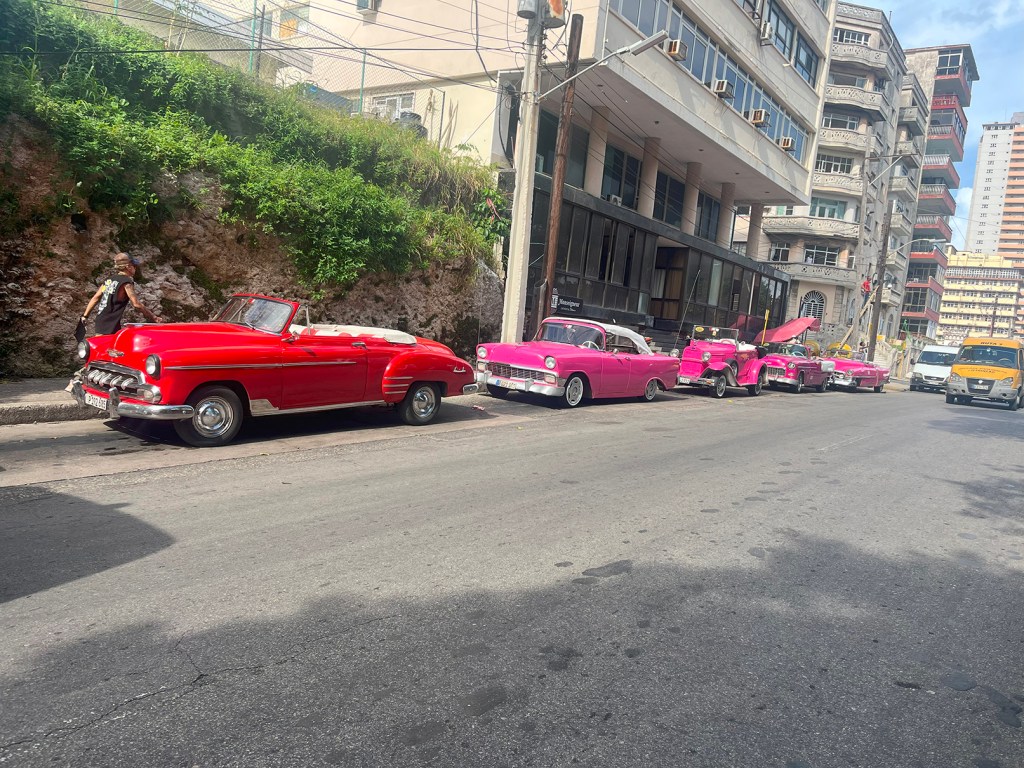
Close to the ocean, I approached a large resort that looked quite nice and obviously government-owned. I pulled into the front entrance and tried to find my way around the back so I could get to the ocean. Looking something like a local, I was stopped by an official and asked to leave. I came back out a different entrance and saw a line of red/pink classic cars with one driving by, so I took a picture and a video.
Down another side street, I got to the ocean. This is Malecon Street and the street that you typically see when you see pictures and movies about Havana with beautiful high-rise resorts facing the ocean. There actually were some government-run resorts that maintain some degree of opulence, but with few tourists checked in to pay the bills, it appeared that everything was sinking fast. I peddled for a while and stopped to enjoy a serenade by Louis, a trumpet player.
That was a great experience and I gave him a couple of dollars. He told me he needed shoes and I told him I would meet him back there the next morning. Unfortunately, I didn’t get there till after 12 and didn’t see him. Heading back along the ocean from my original direction I enjoyed watching the waves crashing over the stone wall and splashing onto the street, often spraying me and once drenching me. The forecast was for the wind and tides to continue to be heavy, which eliminated my plan to take a bus two hours away to a beautiful beach. This was the tail end of the hurricane season and hopefully I won’t get stuck here due to any kind of a hurricane issue.
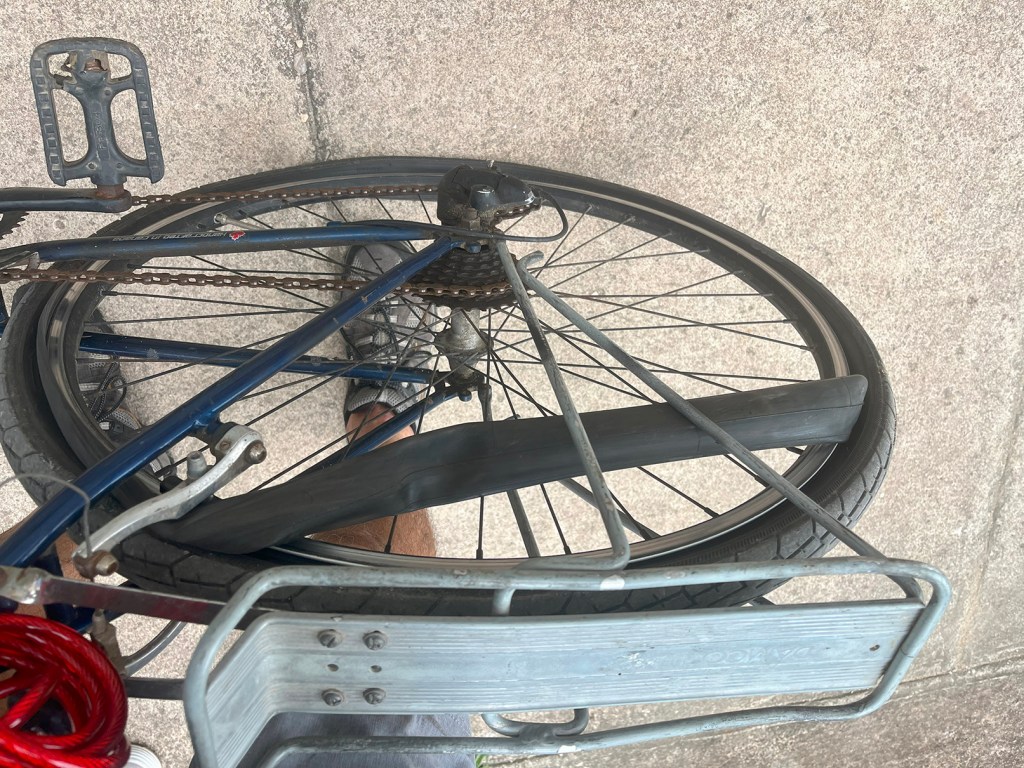
Now heading south to the heart of Havana and up a hill I crossed a wide and busy street. This is where my back tire went flat and my tube bulged out of the tire.
Now walking my bike, I crossed over the median of that street and came across a string of vendors with their wares on steps. I would later learn that they acquired many of these wares by picking through the horrible heaps of trash. “One man’s trash is another man’s treasure.” I fit in okay with the locals as I walked my beat-up bike with a flat tire while scanning the merchants’ items. My hair also looked pretty wild as I decided not to cut it before leaving so that I might be able to support one of the locals to get my haircut. I could see that some had a few items of clothing while others had some batteries and electronic-type stuff, others had hardware like miscellaneous plumbing parts, some with failed electronics from broken cell phones to TV remotes. Now embedded with the unfathomable poverty that I learned I should expect, being a part of it firsthand was another reality check. I decided that this would be a great place for me to accomplish much of my mission. I went back to the bike guy and traded in my bike for a better one, then back to my room where I loaded my backpack with gifts and brought them back to offer to these people. Their desperation was indescribable. I also saw people siphoning gas a few times, this one in a water bottle.
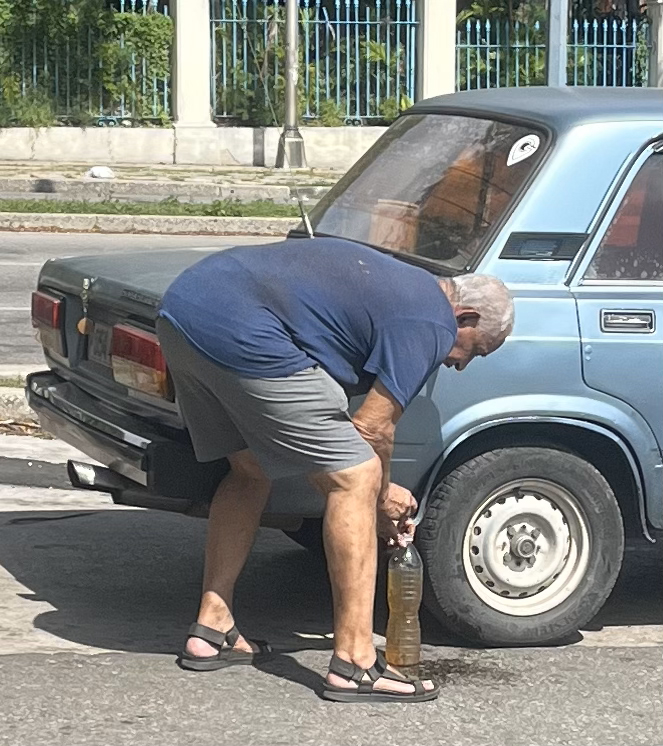
Super valuable gifts to Cubans are tools, especially to fix cars. Tools are heavy but small, so bringing them is worth it. I saw cars with open hoods strewn all over Havana. Many were jacked up with someone sprawled underneath trying to make them run. They often rig Russian parts to work with their mostly American cars.
These people are not alcoholics or strung-out drug addicts. The state of their poverty is through no fault of their own. I attached the backpack to the back of the bike and walked along flashing my phone to the merchants with a message on Google Translate. It said in Spanish, “I would like to give you these gifts, but you must offer it at a fair price to the people who need it most.” They would shake their head and express utter amazement because of the value of what they had just received. If the merchant was selling clothing, I was prepared to give them clothing. If I saw batteries, it was my battery supplies and testers. If they had toiletry items, I gave them the dental supplies, etc. They all tried to talk to me, and I would just say “No comprende Español, only Englase.” None spoke English other than to ask things like “What is your name?” or “Where are you from?” I was told that many people in Cuba speak English, but the fact is that those are only in the high-end government-owned resorts. Without Google Translate, I would have been truly lost. Word got around and their expressions of gratitude were indescribable. One woman reciprocated by giving me a cigar. My gifts went quickly, so I headed back to my room to load up again. I was now “El chico de la bicicleta de Nuevo York,” the guy on the bike from New York, and the people would wave and give me thumbs up as I rode by.
When I stopped, they would approach. It became difficult for me to decide who to give what. I could only do my best. If a man’s face was unshaved I gave him razors. I looked at their feet and gave footwear to those most in need, and those whose shoes I had that might fit. Things began to get testy as they began to swarm like vultures. Their hands were reaching out to me from all directions and I would give each a small item like a few fresh batteries. I finally had to wave my hands in the air and yell “No,” and move my bike, only to have them follow. I then called out, “LINEA, LINEA!” In an attempt to get them to form a line. I pointed in one direction favoring hands that were lined up in that direction, but the swarm continued from all sides as many of us all cheered “LINEA! LINEA!” They continued to swarm with some of us laughing. I handed out a bunch of baseball hats and one of my sombreros to an older woman also cheering “LINEA.” I did this every day and had some fear that they would assault me for my priceless possessions, but I trusted them because I knew these folks were harmless and just desperate. It was all extremely rewarding for me, but barely rewarding for them because this was a momentary event only to be followed by their situation that was so dire.
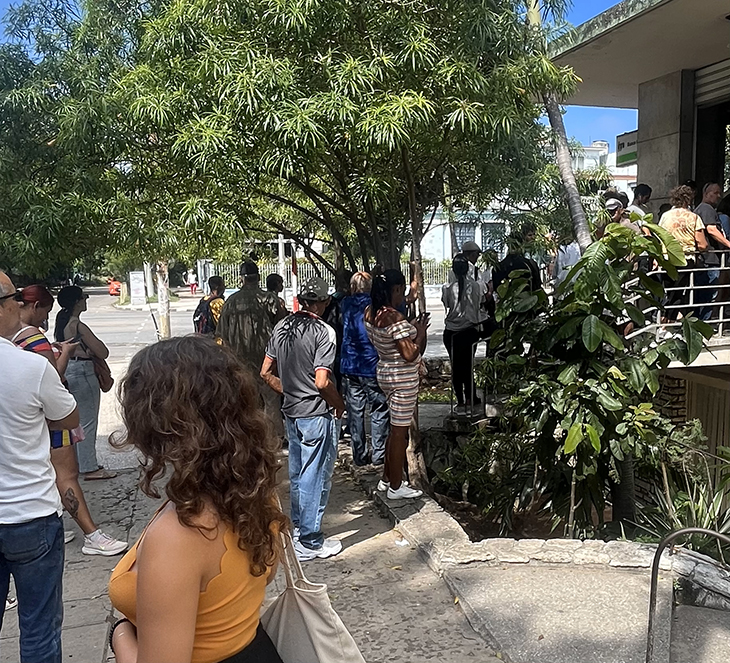
Then heading back to my room I passed a bank that appeared closed with a very long line. It turns out they were all waiting for the power to be restored so the bank could reopen.
There was a park on my way to the Airbnb where I saw some large birds so I decided to bike through it and take a video. As I got closer, it was clear that they were vultures. I stumbled over some type of grave and decided that I would begin the video there and pan around to the vultures. What I then witnessed significantly added to my feelings of how bad things had gotten here in Havana. This was a moment of horror for me. You frequently are warned by videos on television that “This may be disturbing for some viewers.” Please be warned, this video will definitely disturb anyone, so do not click on it unless you are prepared. I don’t think this video would ever be broadcast on network television.
Eventually back to my air-conditioned room, I began to make plans to meet a contact for dinner who I connected with on Facebook. He had told me that visiting Cuba was a regular thing for him. Like me, his was only a humanitarian mission rather than a vacation. His name was Marcelo and having met on Facebook I was as suspicious of him as I expect he might have been of me. After meeting on Facebook, our communication was strictly on WhatsApp, and encrypted. We agreed to meet in the bar at the bottom of his Airbnb and I decided to walk there because I didn’t want to ride my bike back in the dark or bother with a taxi. My walk took close to an hour in the hot sun so I was ready for a cold beer. I only had a face shot of him from the neck up that didn’t reveal much and this left me with even more anticipation. I ordered and contacted Marcelo and he came right down. When he walked in I was taken aback. He was tall, very tall. A black man with an athletic build that you did not want to mess with. Born on French Antigua, Marcelo grew up in the Dominican Republic, as a French citizen he moved to Paris and then to Quebec City 2 years ago where he is a chef in a high-end restaurant. Fluent in French, English, and Spanish, and now my interpreter, Marcelo allowed me to overcome the language barrier that became my greatest obstacle since I arrived here.
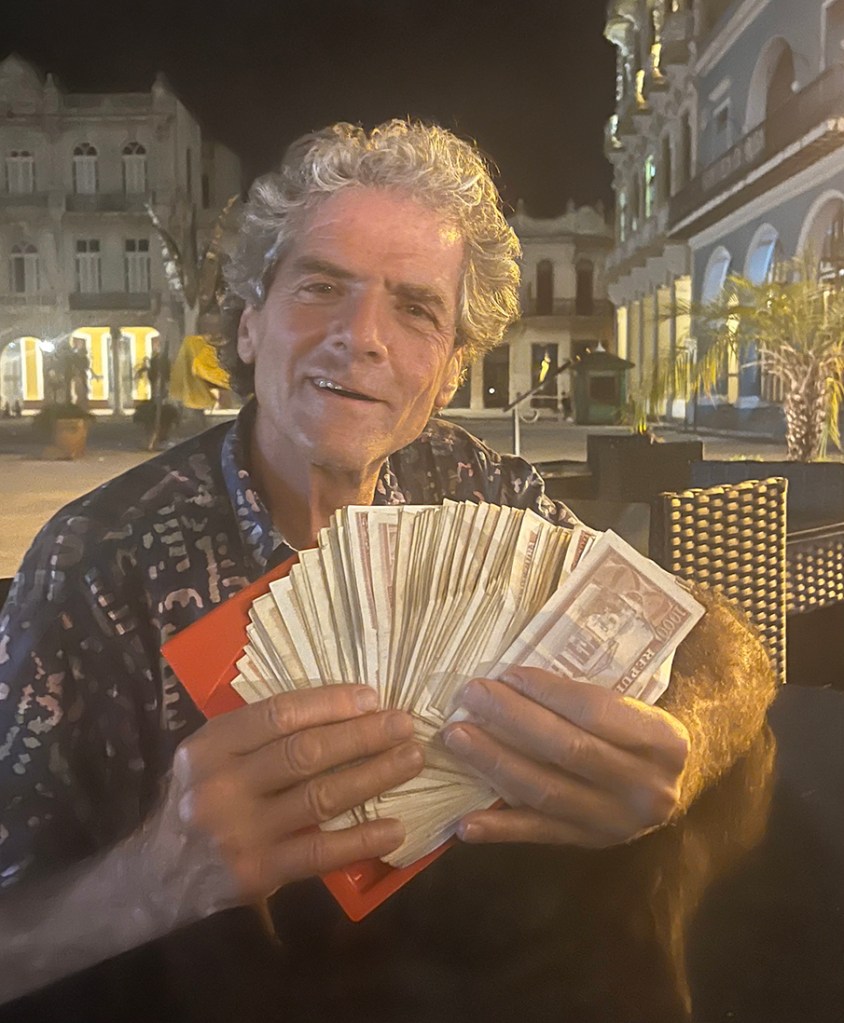
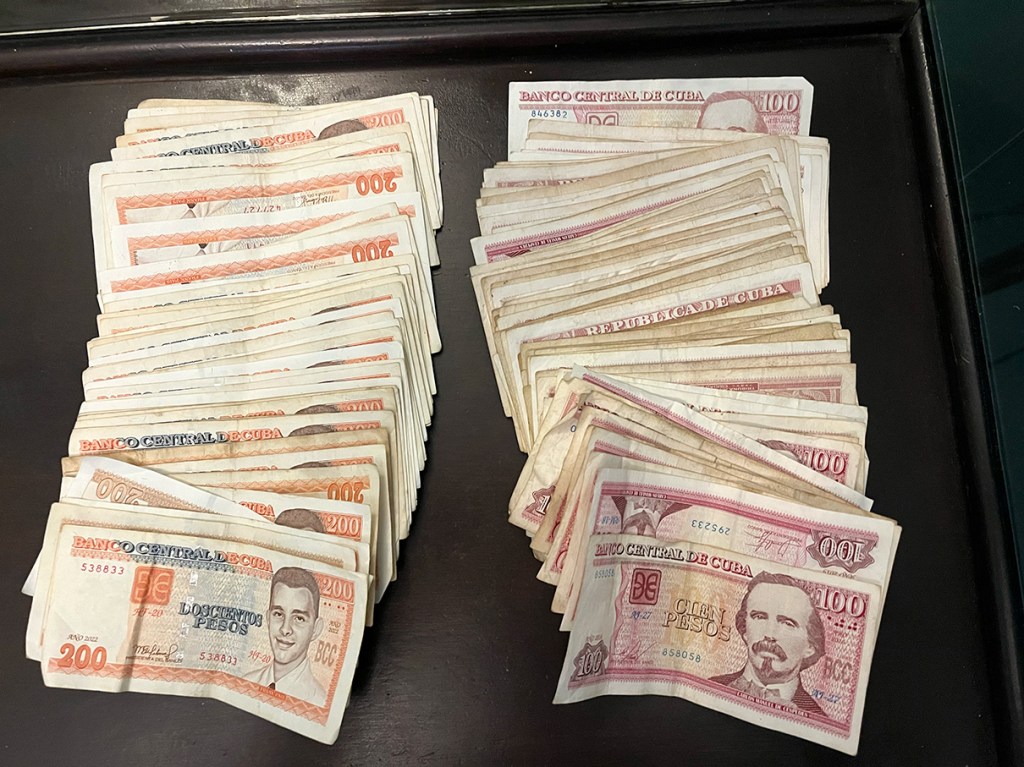
Another thing unique about Cuba is how you pay for things. If you are from the US, credit cards are useless. It’s mostly a cash economy for everyone and the trick is to get the right exchange as if you were a local. A good rate is about 320 pesos per dollar. Exchanging at a bank only gets you half what you can get on the street, but its hard to find 1,000 or 500 peso bills, so you are left with a huge wad of 100 and 200 peso bills and anytime you wanna pay for something it takes an inordinate amount of time to count it and then for them to verify it. Here’s an idea of how we paid for our first meal together
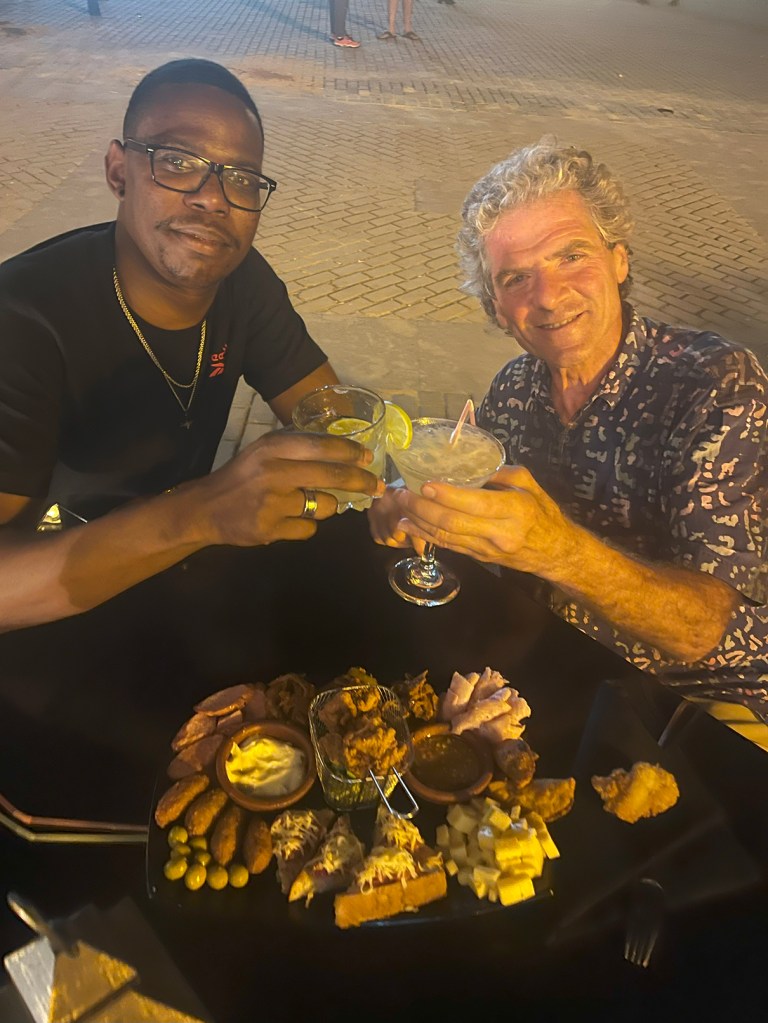
Marcelo provided me with helpful information that I needed to proceed with our mission and when he learned of all the gifts that I had brought we concluded that as a team we could be extremely successful and our partnership became a perfect one. As a chef, he knew where to get the best food at a great price and was able to read the menus and communicate with the staff. His commanding stature meant that I would always be safe and anytime we were together he was always watching out for me. Marcelo took me to “Old Havana” and it turned out to be a nice part of the city. He even knew which establishments to support because they were family-owned, rather than government-owned. We planned our strategy while having dinner and then proceeded to close every bar in Old Havana!
Marcello helped me get a cab home but again my Google Maps didn’t jive with my location so it dropped me off several blocks from my Airbnb at 2:45 AM. It was frightening walking those blocks in the dark in this broken-down city, but when I arrived my host had a helper waiting. He opened the gate and I was home. Now a great friend and someone always looking out for me, Marcelo asked me to be sure to message him to check in when I got to my room. I forgot to do that but it was great to know that he always had my back.
 Rich Citro Adventures