I also asked Eddie about cannabis. Several sources have suggested that it is a good medication for high altitudes. An example of this is referenced by the bestselling book by Jon Krakauer “Into Thin Air“. Eddie looked at me with a stern face and made it clear that marijuana is taboo in Tanzania. “If they catch you with Marijuana they will put you in jail!“. I cannot fathomom what a Tanzanian prison would like. YIKES!!
Catholicism and Christianity are huge here, with Muslim also prominent. Religion may be the best means of stabilization for these desperate people. Without the perception of consequences, the village people may respect no bounds. Eddie also explained that what I was experiencing was largely COVID related as it had killed the tourist business, the number one industry in Tanzania other than precious gems. Moshi is at the foot of Kilimanjaro and the most popular pit-stop for hikers.
At the end of our spectacular day I paid Eddie the $70 fee with a $100, telling him to keep the change and throwing in an additional $20,000 shillings, 2 equal bills that I asked him to use for his 3 year old daughter and 6 year old son. About a $39 tip in total that likely exceeded his income for any good week. Money Very Well Spent! Then back to the hotel I found the Kilimanjaro Lager to be pretty good. The fish dinner was quite bad.
The next morning at 9:00 AM I was picked up by the Berundi and my support group and we were on our way to Kilimanjaro! The condition of the van looked OK on the outside, with their brand emblem prominently displayed, but the condition of the interior took me back a bit. Though very crude by our standards, it was clearly in better shape than most of the other vehicles on the roads. The roads are what you would expect in any third world country, and their driving in the left side of the road definitely put me on edge, but the cultural experience was part of what I was there for. Glad Nancy
wasn’t with me!
Our van carried the driver and a sweet woman in the front passenger seat named Darcy. Her English was better than anyone I had spoken to on my entire trip. I sat behind them with Berundi by my side and 6 others jammed in back. The camaraderie of these folks was extraordinary. They jabbered about in Swahili relentlessly and most of the syllables were that of laughter. This went on for the
entire 2-hour drive with me and my guide conversing only occasionally. I would love to understand what they were saying to learn how they keep one another so well entertained.
The folks that I was with wanted to stop for lunch so we did so at the largest village between Moshi and the National Park, Sanya Juu. As we traveled from one poverty-stricken village to the next continued to experience how real and profound poverty can be in our world. Sanya Juu epitomized this reality. I needed to use the bathroom and this was a local village with no intention of impressing visiting tourists. That open air bathroom, frightening and deplorable by our standards, was what they consider normal. Back to my table I sat next to Darcy and we chatted a bit as they served our lunch. This was unquestionably the worst meal I have ever eaten at a restaurant or anywhere. I have visited rural areas of other third world countries such as Costa Rica and Vietnam and they would be considered gourmet by comparison. During our lunch, a street vendor visited our table peddling portable lights. Darcy was interested and I suggested the LED type. Her eyes lit up as she liked it a lot, but 18,000 shillings, about 9 bucks, was way more than she could afford. I offered to buy it for her and she answered by saying “That would help me”. She never said thank you, and I noticed that saying thank you, “Assente” in his Swahili, was rare. I never heard it when sharing my snacks with my support group or when they shared among one another. Unlike our culture, sharing is not considered generosity to these native people. Sharing is expected as it is necessary for their overall existence
Back on the road we were about 30 minutes to the park entrance. Special clearance is required including a registered guide to enter. They paid the entrance fee and demonstrated the necessary paperwork and we began our ascent driving through the cultivation zone. The vegetation appeared quite interesting though Darcy commented disparagingly, “It’s all man-made”. There were crops of all kinds such as beans, potatoes, maize, and corn, but most frequently bananas. Bananas are everywhere in Tanzania and there are 36 types for various purposes, including beer. They’ll produce a large bunch which is then harvested and the plant cut to its stump. Within nine months another full-grown plant and bunch of bananas is ready for harvest again. Banana trees are also used because other types of farm products require shade, so the banana leaves benefit the crops growing beneath them. Nearly all the farm products in Tanzania were imported by the Germans who ran the country until WW1 when the British took it over. I was impressed with their cultivation methods as they are quite sustainable and regulated by the government. For example, cows will eat any of the leftover vegetation from the banana trees and then roam freely where their excrement provides for fertilization, and the process continues.
OK! It’s Wednesday November 17th at around 1:30 and we’re at the park entrance at the Londrossi Gate. I was required to sign a statement before entering the park confirming that I am not carrying any more than 20,000 shillings on my person or in my gear. I was unaware of this, so I lied. By then I understood the desperation of these people so for various reasons this made sense to me. This is the start the Lemosho route and my support group are organizing all the gear and dividing it up so they can be on their way! Porters typically carried my stuff and the rest of the expedition gear in a duffel bag that they balance on their heads. I believe this is the case because they cannot afford backpacks. I had chosen the Lemosho route as it offered the best options for steady inclines and favorable acclimatization. Our first night was to be spent at the MKUBWA Camp, a 4 mile 2,362’ climb to 9,500’. LET’S DO THIS!!!
My research demonstrated what Berundi was teaching me. Hiking behavior is different than back home. “Pole Pole” is the rule. That is, slow and steady wins the race, because acclimatization is the goal. It didn’t take much getting used to because the altitude caused the behavior to be automatic and gave me good reason to just shuffle along. About 2 miles into the trail, I was positioned with Berundi behind me and a porter in front of me. At this point I had few conversations with Berundi and he knew nothing about me or my capabilities. As their Swahili jabbered back and forth with laughter flying by my ears, I decided to break the ice. We were at about 8,500 feet now in the Rain Forrest zone and it was hot and sunny. I was using my handkerchief to wipe the sweat off my brow and decided to stop using the handkerchief and let the sweat cover my face. I then found a tree stump to sit on and waited for Berundi to approach. He said “You OK?” I answered, “I need to stop. I am very tired. I think I want to go home”. By this time the entire team were far ahead leaving the implications rather unfortunate for him, including losing the tips that they all relied upon. I saw his face go from concerned to depressed. He then said “Are you serious?” I then burst out into laughter and watched Berundi’s expression do a 180. The following day we were hiking over Elephant Back Ridge. I asked Berundi if he ever heard the story of “The Boy Who Cried Wolf”. He said no, so I told him the story. I then asked him if I truly fooled him the previous day when I told him that I wanted to go home. He said, “You had so much sweat on your face”. I then said, “Please understand Berundi, if I cry wolf again, to take it seriously!”
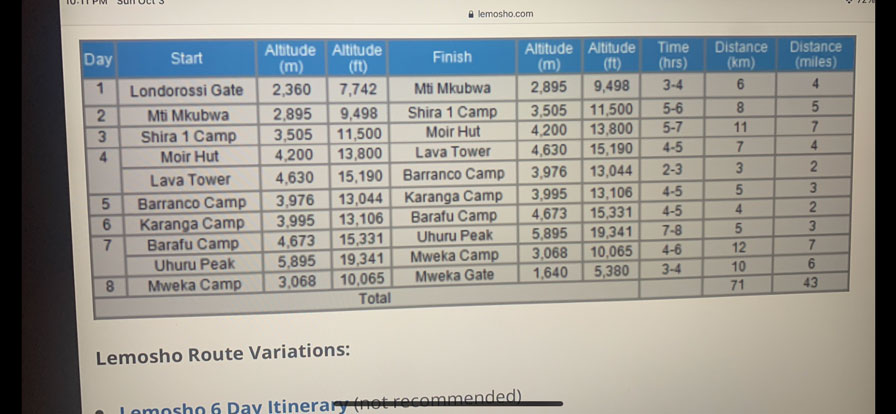
Arriving at the MKUBWA camp at about 4:30 PM I only noted one other tent site with a French couple who I would meet days later. Throughout the entire trip we did not speak much. I don’t believe the man spoke any English while the woman’s English was perfect, accompanied by her sexy French accent. The most significant conversation between us was a comment that I made to her when we were heading to base camp days later. I told her that, “In my experience, I find women to be better hikers than men, but in this particular scenario, having to pee so frequently in the freezing cold nights must put you at a distinct disadvantage”. I was hoping to get a giggle but found her response her rather dull. It might have been the French – American thing. They did get to base camp before me and I was delighted to hear her say to me “Good Job”. Other than that, for the balance of the hike I would only have brief conversations with six other white guys; Four from the Czech Republic and two Dutchman. All great guys! Overall, though, you were typically either in your tent or hiking.
When I arrived, I found that my porters had set up my tent and put the duffel bag inside with the rest of my gear. There was a chill in the air and when the sun goes down around 6:30 it goes from a chill to cold. The cold increased each night with the elevation gain. My tent was definitely much warmer. There are also lodges at camp sites. Though primitive they are actual buildings with beds that you can stand up in, but I didn’t see anyone using them. I guess tenting it is the prevalent mentality here. The routine each night, on the part of the support staff, was the same. Jessie unzipped my tent and presented a bowl of hot water. He would say, “Water for washing”. The bowl looked like something you use for a water bowl for a large dog. I usually didn’t use it and after a day or so would just say, “I don’t need it. Please share it with your friends”. Jesse would then visit a few more times, first with a thermos of hot water and selection of tea, coffee, or other hot choices. The thermos was a good one and kept the water hot for several hours. The second course was soup or porridge. The cucumber soup was OK. Everything else was not. The third course was the main course and I learned from day one that only the fruit and some vegetables were edible. There would be a huge plate of spaghetti or rice that were mushy, dry and so tastes that I found the repulsive. I tried to dress them up with some of the stew or whatever alternative concoction the evening presented, all of which allowed for a few forks full before my surrender. After dinner Burundi unzipped my tent to brief me on the following days activities and use a finger monitor to test my oxygen level. 82 on night 1. I didn’t know what that meant but he approved. As I sat uncomfortably in this cold-and-getting-colder tent, realizing how much time I would be spending alone there, I was beginning to come to terms with of exactly what I had gotten myself into.
I’ve camped plenty of times in my life but not much recently. It had been decades since camping temperatures were in unfavorable weather conditions and if rain was in the forecast we just canceled. Pulling off an expedition of more than a few days was also something of the past. I reviewed all of my possessions strewn throughout the tent and immediately recognized that I was completely disorganized. There was so much stuff I didn’t need that it caused me to carry stuff unnecessarily. More importantly, I found it hard to find what I needed, when I needed it. This became goal number one. Get this shit organized! The next issue that I discovered, and never overcame, was that once I got into my tent after the day of hiking, I found myself falling asleep right away and that was typically around or before 5:00. Because of the uncomfortable sleeping conditions, shortly after having had a few hours’ sleep I woke up in the cold night and could not get back to sleep. That means it’s now around 8:00 at night and there’s not much to do for the next 10 hours or more, thus the creation of “My African Adventure!”.
I always hike with my “Alite” light weight, 2 footed chair. I balance the 2 back legs with my front 2 feet. I demonstrated this to Berundi when we first met at our “Gear Meeting”. He had never seen one but agreed that this lightweight furniture was a good idea. My Alite turned out to be the most valuable piece of furniture that I ever purchased! The sleeping pad that they provided barely met my comfort standards and only did because I am ok with a very stiff mattress. Glad Nancy wasn’t there! My biggest sleeping issue was the pillow. Anything that I tried got squished down and felt like concrete. Nancy has a hiker’s pillow that I could have packed but I never could understand why I would hike with a pillow. In retrospect that pillow may have become the most valuable bedding material that I had ever owned. My short-term solution? The Ziplock plastic bag.
There is a story behind this. I was amazed to learn that Tanzania has some environmental regulations that are more practical than our own. When I landed at Kilimanjaro International Airport, a British chap came onto the intercom and made an announcement. “Tanzania has outlawed plastic bags. You are required to remove any plastic bags from your luggage and place them in the seat pocket in front of you so that we may properly deal with them”. My primary method of organization all of my stuff is the Ziplock plastic bag! I am very good about them from an environmental standpoint, reusing them many times and Nancy and I sometimes even put them in the dishwasher. Now however, I dumped over a dozen bags of various things into my backpack, going from perfectly organized, to a state of complete disorganization. I then stuffed all the Ziplocks into one of the bags and put it in the seat pocket in front of me. There were separate bags for phone chargers, non-phone chargers, Apple headphones, non-Apple headphones, wireless headphones, international adapters, AAA batteries, flashlight barrel batteries, my iPad, disinfectant, snacks, hiking related paperwork, Safari related paperwork, home paperwork, airline paperwork, toiletry stuff, and even more stuff! And that is only things that are in my carry-on backpack.
My luggage included MANY plastic bags to separate most of my camping things, as well as electronics like my GoPro and selfie stick, GoPro batteries, and plenty of other stuff in separate bags. Part of the hike requires travel through a rain Forrest during the “Partial Rainy Season”, so this all made sense to me. Would they examine my luggage seeking plastic bags as if looking for drugs, explosives, or firearms? Turns out they did nothing of the kind. When I went through my gear with Berundi, he told me to simply use them as originally intended. Just be sure to bring them back to the US when you go home.
So let’s give that Ziplock pillow a try! Fill it up with air, put it in a shirt, and use it as a pillow. I found out that it actually worked…for a while. Because your ear is directly on the plastic pillow you can hear a subtle sound almost like a muffled bump. Each bump sound corresponded to a slight deflation of the pillow. The strategy was to employ the pillow when you felt rather tired. You then had about 15 minutes to fall asleep before it again felt like concrete. By then I would hope to be asleep soundly enough to be somewhat unaffected by the discomfort. Again, eating and sleeping became among the biggest challenges during this adventure. Kind of important, wouldn’t you say?
 Rich Citro Adventures